Applied ChemistryUnit 715 min read
Lubricants: Types, Functions & Engineering Applications
Unit 7 of Applied Chemistry explores lubricants—how they reduce friction, prevent wear, and enhance efficiency in mechanical systems, covering their types (liquid, solid, gaseous), properties, additives, and real-world applications in engines, bearings, and industrial machinery.
TAKEAWAYS:
- Lubricants reduce friction and wear by forming protective films between moving surfaces, classified into liquid (oils), solid (graphite, molybdenum disulfide), and gaseous (air) types.
- Viscosity and additives (anti-wear, extreme-pressure) determine a lubricant’s performance in high-stress applications like automotive engines or industrial gearboxes.
- Greases are semi-solid lubricants combining oils with thickeners (e.g., lithium soap) for high-load applications like wheel bearings.
- Environmental and health impacts of lubricants (biodegradability, toxicity) are critical in modern engineering, e.g., synthetic esters in eco-friendly hydraulic systems.
- Lubrication mechanisms (hydrodynamic, boundary, elastohydrodynamic) explain how lubricants work under different loads and speeds.
- Exam focus: Compare lubricant types, explain viscosity-temperature relationships, and link lubricant failure to corrosion or wear in mechanical systems.
1. What Are Lubricants?
Lubricants are substances—liquid, solid, or gaseous—applied between moving surfaces to:
- Reduce friction (energy loss as heat).
- Minimize wear and tear (preventing metal-to-metal contact).
- Dissipate heat generated during operation.
- Seal joints (e.g., in piston rings).
Why does friction matter? Friction converts mechanical energy into heat, reducing efficiency. For example, in a car engine, ~10–20% of fuel energy is lost to friction without proper lubrication. Lubricants cut this loss by forming a protective film between surfaces.
2. Types of Lubricants
Lubricants are classified based on physical state and application. Below is a comparison table with key properties:
| Type | Examples | Applications | Advantages | Disadvantages |
|---|---|---|---|---|
| Liquid | Mineral oil, synthetic oil, bio-oil | Engines, gearboxes, hydraulic systems | High heat capacity, easy to pump | Degrades at extreme temps, flammable |
| Solid | Graphite, molybdenum disulfide (MoS₂), PTFE (Teflon) | High-vacuum systems, space applications | Works at extreme temps, no leakage | Low heat dissipation, abrasive if misused |
| Gaseous | Air, nitrogen, SF₆ (sulfur hexafluoride) | Air bearings, gas turbines | No contamination, inert | Limited load-bearing capacity |
| Grease | Lithium grease, calcium grease | Wheel bearings, railway axles | Stays in place, resists water | Hard to remove, can harden with age |
3. Liquid Lubricants: The Workhorses
Most engineering applications use liquid lubricants, primarily mineral oils (derived from crude oil) or synthetic oils (engineered for specific needs).
A. Mineral Oils
- Source: Refined from petroleum crude oil.
- Composition: Hydrocarbons (alkanes, cycloalkanes, aromatics).
- Example: SAE 30 motor oil (used in cars).
- Limitation: Degrades at high temperatures or under heavy loads.
B. Synthetic Oils
- Types:
- Polyalphaolefins (PAOs): High thermal stability (used in Formula 1 engines).
- Polyglycols: Water-miscible, used in metalworking fluids.
- Silicon-based oils: Heat-resistant, used in aerospace.
- Advantage: Longer lifespan, better performance in extreme conditions.
C. Bio-Based Lubricants
- Source: Vegetable oils (e.g., canola, soybean) or animal fats.
- Example: Used in eco-friendly hydraulic systems (e.g., in some agricultural machinery).
- Advantage: Biodegradable, low toxicity.
4. Key Properties of Liquid Lubricants
A. Viscosity: The "Thickness" of a Lubricant
Viscosity () measures a fluid’s resistance to flow. It is temperature-dependent:
- High viscosity: Thick oil (e.g., SAE 90 gear oil) → good for high loads but hard to pump.
- Low viscosity: Thin oil (e.g., SAE 5W-30) → flows easily but may not protect well under heavy loads.
Viscosity Index (VI): A number indicating how viscosity changes with temperature. Higher VI = better performance in varying temps.
- Example: SAE 5W-40 has a high VI, suitable for Nepal’s hot summers and cold winters.
B. Flash Point and Fire Point
- Flash point: Lowest temperature at which a lubricant gives off enough vapor to ignite briefly.
- Fire point: Temperature at which it burns continuously.
- Example: Mineral oil has a flash point of ~200°C, while synthetic oils can exceed 300°C.
C. Pour Point
The lowest temperature at which a lubricant can flow. Critical for cold climates (e.g., Pokhara winters).
- Example: SAE 0W-20 has a pour point of -40°C, ideal for high-altitude vehicles.
5. Lubrication Mechanisms
How lubricants work depends on the load and speed of moving parts. Three primary mechanisms:
A. Hydrodynamic Lubrication
- How it works: A thick fluid film separates moving surfaces (e.g., journal bearings in engines).
- Condition: High speed, moderate load.
- Example: Crankshaft in a car engine (oil wedge forms under rotation).
B. Boundary Lubrication
- How it works: Surfaces are almost in contact; lubricant forms a monomolecular layer (e.g., additives like fatty acids).
- Condition: Low speed, high load (e.g., gear teeth meshing).
- Example: Clutch plates in a motorcycle.
C. Elastohydrodynamic (EHD) Lubrication
- How it works: High pressure deforms surfaces, creating a very thin, high-pressure film (e.g., in camshafts).
- Condition: High contact stress (e.g., roller bearings).
6. Additives: Enhancing Lubricant Performance
Additives improve properties like oxidation resistance, anti-wear protection, and extreme-pressure performance. Common types:
| Additive Type | Function | Example | Application |
|---|---|---|---|
| Anti-wear | Forms protective films on metal | Zinc dialkyldithiophosphate (ZDDP) | Engines, gearboxes |
| Extreme-pressure (EP) | Prevents metal-to-metal contact | Chlorinated paraffins | Heavy machinery, drills |
| Viscosity index improvers | Reduces viscosity change with temp | Polyisobutylene (PIB) | High-performance motor oils |
| Detergents | Keeps engine clean by suspending sludge | Calcium sulfonates | Diesel engines |
| Corrosion inhibitors | Protects metal surfaces from rust | Organic acids (e.g., oleic acid) | Hydraulic systems |
7. Solid Lubricants: When Liquids Fail
Used in extreme conditions where liquids cannot be used (e.g., high vacuum, space applications).
A. Graphite
- Structure: Layered hexagonal carbon (weak van der Waals forces between layers).
- How it works: Layers slide over each other under pressure.
- Example: Used in pencil leads (graphite + clay) and high-temperature bearings.
B. Molybdenum Disulfide (MoS₂)
- Structure: Sandwich of Mo-S-Mo layers.
- Advantage: Works in vacuum and high temps (up to 400°C).
- Example: Lubricating spacecraft joints or nuclear reactors.
C. Polytetrafluoroethylene (PTFE, Teflon)
- Property: Lowest coefficient of friction of any solid.
- Example: Used in non-stick cookware and seals in chemical plants.
8. Greases: Semi-Solid Lubricants
Greases are oils thickened with soaps or clays, used where liquids would leak (e.g., wheel bearings).
A. Composition
- Base oil: Mineral or synthetic oil (70–90%).
- Thickener: Lithium soap, calcium grease, or bentonite clay.
- Additives: Anti-oxidants, corrosion inhibitors.
B. Types and Applications
| Type | Thickener | Application |
|---|---|---|
| Lithium grease | Lithium soap | Automotive wheel bearings |
| Calcium grease | Calcium soap | Food processing equipment |
| Aluminum complex grease | Aluminum soap | High-speed bearings (e.g., electric motors) |
C. Why Use Grease?
- Stays in place (no leakage).
- Resists water (e.g., marine applications).
- Protects against dust (e.g., railway axles).
9. Gaseous Lubricants: The Invisible Shield
Used where contamination is unacceptable (e.g., semiconductor manufacturing).
A. Air
- Example: Air bearings in precision machinery (e.g., hard disk drives).
- Advantage: No wear, no leakage.
B. Nitrogen (N₂)
- Example: Used in vacuum systems (e.g., electron microscopes).
C. Sulfur Hexafluoride (SF₆)
- Example: High-voltage electrical switches (insulating gas).
10. Lubricant Failure and Corrosion
Lubricants fail due to:
- Oxidation: Reaction with oxygen → forms sludge/varnish.
- Example: Old engine oil turns black and viscous.
- Contamination: Dust, water, or fuel dilution.
- Example: Water in diesel fuel → microbiological growth (fuel bacteria).
- Thermal breakdown: Oil breaks down at high temps → loses viscosity.
- Additive depletion: Anti-wear additives get used up over time.
Corrosion Risk:
- Acid formation: Oxidized oil produces carboxylic acids, corroding metal parts.
- Rust: Water ingress in stored lubricants (e.g., unused gear oil in a warehouse).
11. Environmental and Health Impacts
| Issue | Cause | Solution |
|---|---|---|
| Toxicity | Heavy metals (e.g., lead in old oils) | Use low-toxicity synthetic oils |
| Biodegradability | Mineral oils persist in soil/water | Switch to bio-lubricants (e.g., ester-based) |
| Greenhouse gases | Oil refining emits CO₂ | Use recycled or vegetable-based oils |
Example: Nepal’s NTC (Nepal Telecom) uses biodegradable hydraulic fluids in its data centers to reduce environmental harm.
In the Real World
Pathao and Daraz Logistics:
- Idea Used: Grease in wheel bearings.
- How: Delivery vehicles (e.g., Pathao motorcycles, Daraz vans) rely on lithium grease in wheel hubs to reduce friction and prevent overheating during long routes in Kathmandu’s traffic. Poor lubrication would cause bearing failure, leading to accidents or breakdowns.
Nepal Rastra Bank (NRB) and ATM Machines:
- Idea Used: Synthetic hydraulic oil in ATMs.
- How: ATMs use fire-resistant synthetic oils in their hydraulic systems to ensure smooth cash dispensing. Mineral oil would risk ignition if the ATM overheats, while synthetic oil resists breakdown at high temps.
Ncell and NTC Base Stations:
- Idea Used: Solid lubricants (MoS₂) in cooling fans.
- How: Telecommunication towers in remote areas (e.g., Mustang) use molybdenum disulfide-coated bearings in cooling fans. These bearings withstand dust and extreme temps (up to 400°C), ensuring 24/7 uptime without maintenance.
Worked Example: Calculating Viscosity Impact on Fuel Efficiency
Scenario: A truck uses SAE 15W-40 oil (viscosity index = 120) in summer and SAE 5W-40 oil (VI = 160) in winter. Compare their fuel efficiency if the engine loses 5% efficiency per 100 cSt increase in viscosity at operating temperature.
Given:
- Summer oil viscosity at 100°C: 12 cSt.
- Winter oil viscosity at 100°C: 9 cSt.
- Baseline fuel efficiency: 10 km/L.
Steps:
- Calculate viscosity difference: .
- Efficiency loss: 3 \, \text{cSt} \times 0.05 \, \text{(5% per 100 cSt)} = 0.15 \, \text{or} \, 15\%.
- Adjusted fuel efficiency in summer: .
- Winter efficiency remains 10 km/L (negligible loss).
Conclusion: Using 5W-40 in summer could improve fuel efficiency by ~15%, saving ~1.5 L fuel per 100 km—critical for long-haul trucks in Nepal’s mountainous terrain.
12. Exam Tip: How to Score Full Marks
Define and Classify:
- Always start with clear definitions (e.g., "Lubricants are substances that...").
- Use comparison tables for types (liquid/solid/gaseous) to show understanding.
Link to Real Systems:
- Engine examples: Explain how SAE grades relate to Nepal’s climate (e.g., 5W-30 for summer, 10W-40 for high-altitude areas).
- Failure analysis: Describe how oxidized oil causes engine sludge (show with a real image of a clogged oil filter).
Mechanisms Matter:
- Draw a mermaid diagram of the three lubrication regimes (hydrodynamic, boundary, EHD) with arrows showing conditions (speed/load).
- Example question: "Why does a car’s differential gear use EP additives?" → Answer: High contact stress → boundary lubrication → need for extreme-pressure films.
Additives and Properties:
- Memorize 3 key additives (e.g., ZDDP for anti-wear) and their real-world uses (e.g., in Ncell’s backup generators).
- Viscosity-temperature graphs are common in exams—practice sketching them.
Environmental Angle:
- 1 mark can be gained by mentioning biodegradable lubricants in eco-friendly applications (e.g., hydraulic systems in organic farms).
Visual Summary
classDiagram
  class Lubricant {
      +reduce_friction()
      +prevent_wear()
      +dissipate_heat()
      +cool_system()
      +seal_joints()
  }
  class LiquidLubricant {
      +mineral_oil()
      +synthetic_oil()
      +bio_oil()
      +properties: viscosity, flash point, pour point
  }
  class SolidLubricant {
      +graphite()
      +MoS2()
      +PTFE()
      +properties: high-pressure resistance
  }
  class Grease {
      +lithium_grease()
      +calcium_grease()
      +properties: semi-solid, thickener + base oil
  }
  Lubricant <|-- LiquidLubricant
  Lubricant <|-- SolidLubricant
  Lubricant <|-- Grease
  Lubricant --> "Applications: Engines, Bearings, Gears, etc."
Hierarchy and key properties of lubricant types with real-world applicationsflowchart TD A["High Speed\nModerate Load\n→ **Hydrodynamic Lubrication**"] -->|"Full Fluid Film"| B["Example: Journal Bearings"] C["Low Speed\nHigh Load\n→ **Boundary Lubrication**"] -->|"Additive Films"| D["Example: Gear Teeth"] E["Very High Pressure\n→ **Elastohydrodynamic (EHD)**"] -->|"Thin, High-Pressure Film"| F["Example: Camshafts"] G["Extreme Conditions\n→ **Solid Lubricants**"] -->|"Graphite/MoS₂"| H["Example: Space Mechanisms"]Lubrication regimes with real-world engineering examples and conditions
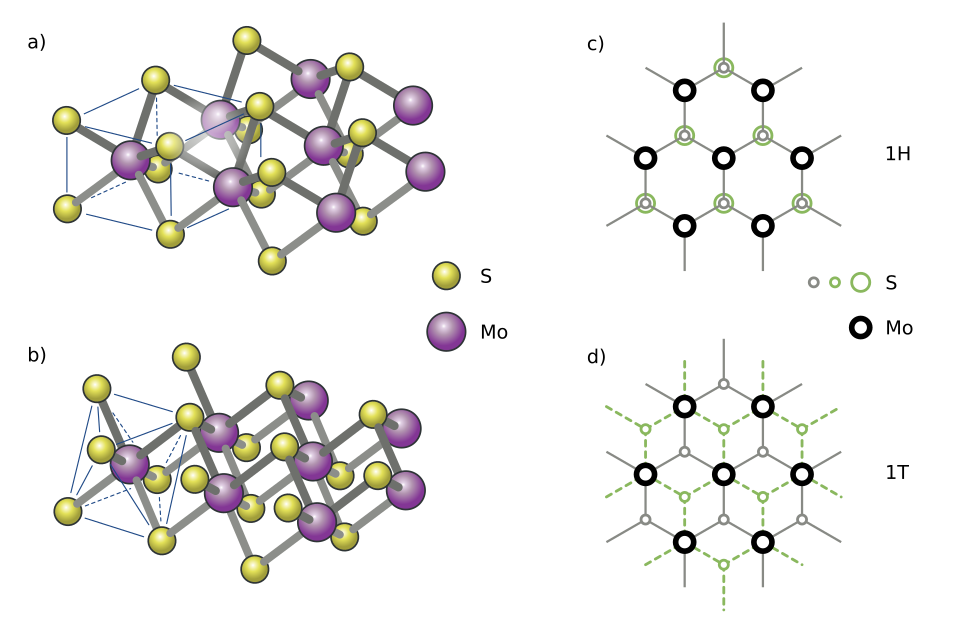 Hexagonal layered structure of MoS₂, showing how layers slide under pressure. (Image: Jozef Sivek, CC BY-SA 4.0, via Wikimedia Commons)
Based on the PU BE Computer (PU) syllabus for Applied Chemistry (CHM110), unit 7.
Discussion
Loading…