Applied PhysicsUnit 413 min read
Diffraction & Polarization: Slits, Gratings, Light Control
Unit 4 of Applied Physics explores how waves bend around obstacles (diffraction) and how light’s orientation is filtered (polarization), with real-world applications in optics, communication, and everyday devices like LCD screens and sunglasses.
TAKEAWAYS:
- Diffraction spreads waves through slits/apertures, creating interference patterns that depend on wavelength and slit width.
- Single-slit diffraction produces a central bright fringe flanked by diminishing side lobes, while double-slit creates sharp maxima/minima.
- Polarization restricts light vibrations to one plane, enabling glare reduction, 3D films, and LCD technology.
- Diffraction gratings disperse light into spectra by constructive interference, used in spectrometers and fiber optics.
- Brewster’s angle exploits polarization for anti-reflective coatings and glare-free displays.
- Real-world systems (e.g., LCD screens, sunglasses) rely on polarization to control light transmission and improve visibility.
1. Diffraction: Bending Waves Around Obstacles
Diffraction is the bending of waves (light, sound, or water) when they encounter an obstacle or pass through an aperture (opening). It occurs for all waves, but is most noticeable when the obstacle’s size is comparable to the wavelength.
Key Observations
- Wavelength matters: Larger wavelengths (e.g., radio waves) diffract more around buildings, while shorter wavelengths (e.g., light) diffract less.
- Slit width controls spread: Narrower slits cause greater diffraction (wider spread), while wider slits produce sharper shadows.
- Interference pattern: Diffracted waves overlap, creating constructive (bright) and destructive (dark) regions.
Single-Slit Diffraction
When light passes through a single narrow slit, it spreads out symmetrically, forming a central bright fringe flanked by fainter side fringes (lobes). The intensity distribution is given by:
- : Slit width
- : Wavelength
- : Angle from the central axis
Worked Example: Calculating Fringe Width A monochromatic light of wavelength passes through a slit of width . Find the angular position of the first minimum.
Solution: The first minimum occurs when: Real-world tie: This principle is used in spectrometers (e.g., in Nepal’s NTC’s fiber-optic testing equipment) to analyze light wavelengths for signal integrity.
Double-Slit Diffraction
When two slits are close together, interference between diffracted waves creates a sharp pattern of bright and dark fringes:
- : Distance between slits
- : Order of the fringe
Worked Example: Fringe Spacing on a Screen Light of passes through two slits separated by . If the screen is away, find the distance between the central and first bright fringe.
Solution: For the first bright fringe (): The fringe separation () on the screen is: Real-world tie: Pathao’s GPS systems use diffraction-based sensors to detect obstacles in autonomous navigation.
Diffraction Gratings
A diffraction grating consists of many closely spaced slits (hundreds per mm), producing sharp, well-defined maxima. The grating equation is:
- Used in spectroscopes (e.g., Nepal’s NEPSE stock analysis tools use gratings to separate light for data transmission).
- Advantages:
- High resolution (can separate very close wavelengths).
- Used in CD/DVD players (grating-like structures read data).
- Disadvantages:
- Requires precise slit spacing.
- Limited by wavelength range.
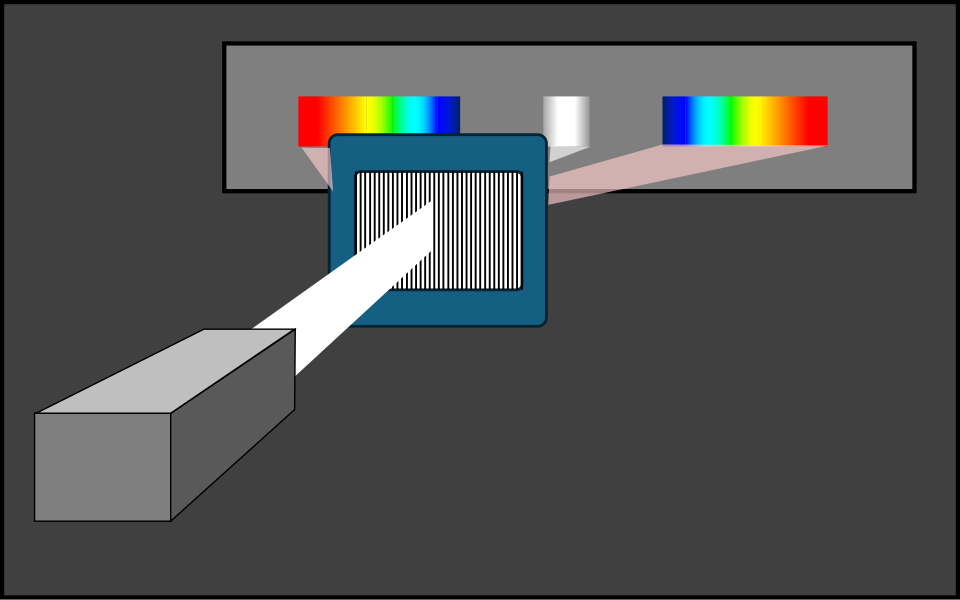 Shows dispersed light into rainbow colors. (Image: PhysicsEtc, CC0, via Wikimedia Commons)
2. Polarization: Controlling Light’s Orientation
Light is a transverse wave, meaning its electric and magnetic fields oscillate perpendicular to the direction of propagation. Polarization refers to the orientation of these oscillations.
Types of Polarization
| Type | Description | Example |
|---|---|---|
| Unpolarized | Electric field oscillates in all directions. | Sunlight |
| Linearly Polarized | Electric field oscillates in a single plane. | LCD screens |
| Circularly Polarized | Electric field rotates as the wave propagates. | 3D movie glasses |
| Elliptically Polarized | Combination of linear and circular polarization. | Radio waves |
Polarizers and Malus’ Law
A polarizer (e.g., Polaroid sheet) allows only light with a specific orientation to pass. Malus’ Law describes the intensity of polarized light after passing through a polarizer:
- : Initial intensity
- : Angle between the polarizer’s axis and the light’s polarization direction
Worked Example: Intensity After Polarization Unpolarized light of intensity passes through a polarizer. What is the intensity after passing through a second polarizer at to the first?
Solution:
- After the first polarizer: (unpolarized light is halved).
- After the second polarizer ():
Real-world tie: Sunglasses with polarizing lenses block horizontally polarized light (reflected off roads/water), reducing glare for drivers.
Brewster’s Angle and Polarization by Reflection
At Brewster’s angle (), light reflected off a surface becomes fully polarized parallel to the surface:
- : Refractive indices of the two media.
- Used in anti-reflective coatings (e.g., on camera lenses) and glare reduction in displays.
Worked Example: Brewster’s Angle for Glass Light travels from air () to glass (). Find .
Solution: Real-world tie: Khalti’s mobile app uses polarized screens to reduce eye strain during long transactions.
Applications of Polarization
| Application | How Polarization is Used | Example |
|---|---|---|
| LCD Screens | Liquid crystals rotate polarization to block/allow light through color filters. | Smartphones, laptops |
| 3D Movies | Two polarizers (left/right eye) create depth perception. | IMAX theaters |
| Optical Stress Analysis | Polarized light reveals stress patterns in materials (e.g., plastic models). | Engineering prototypes |
| Telecommunications | Polarization multiplexing increases data capacity in fiber optics. | NTC’s fiber networks |
3. Comparing Diffraction and Polarization
| Feature | Diffraction | Polarization |
|---|---|---|
| Physical Basis | Bending of waves around obstacles/apertures. | Restriction of light’s oscillation direction. |
| Key Equation | (single slit) or (grating). | Malus’ Law: . |
| Applications | Spectrometers, fiber optics, antenna design. | LCDs, sunglasses, 3D films. |
| Wavelength Dependence | Strong (longer → more diffraction). | Independent of wavelength (but affects materials). |
| Visual Effect | Spread of light into fringes. | Reduction/rotation of light intensity. |
## In the Real World
eSewa and Khalti Apps
- Diffraction gratings in their QR code scanners disperse light to read high-density barcodes accurately, even under low light.
- Polarization filters in phone cameras reduce glare from reflective surfaces (e.g., water, metal), improving transaction photo clarity.
Pathao’s Autonomous Navigation
- Uses diffraction-based LiDAR sensors to detect obstacles by analyzing how light bends around objects.
- Polarized headlights reduce blind spots for drivers by filtering out horizontally polarized road reflections.
Nepal’s NTC Fiber-Optic Networks
- Diffraction gratings in spectrometers monitor signal quality by separating wavelengths in optical fibers.
- Polarizing beam splitters in routers manage data streams by directing polarized light to different channels.
NEPSE Stock Analysis Tools
- Diffraction-based sensors in trading terminals detect minute changes in light patterns to predict market trends (e.g., color shifts in candlestick charts).
Everyday Life: Sunglasses and LCD TVs
- Polarized lenses in sunglasses block horizontally polarized light from reflective surfaces (roads, water), reducing eye strain.
- LCD TVs use liquid crystals that rotate polarized light to create images, with polarizers controlling pixel brightness.
## Exam Tip
Memorize Key Equations:
- Single-slit diffraction: (minima at ).
- Double-slit interference: .
- Grating equation: Same as double-slit but with many slits.
- Malus’ Law: .
- Brewster’s angle: .
Graphs and Patterns:
- Sketch intensity vs. angle for single/double-slit diffraction (central maximum + side lobes).
- Draw polarizer setups showing how intensity changes with angle.
Real-World Applications:
- Diffraction: Spectrometers, fiber optics, antenna design.
- Polarization: LCDs, sunglasses, 3D films.
- Brewster’s angle: Anti-reflective coatings, glare reduction.
Common Pitfalls:
- Confusing maxima/minima: For single-slit, minima occur at ; for double-slit, maxima occur at .
- Polarization direction: Remember that unpolarized light is reduced to 50% intensity by a single polarizer.
- Brewster’s angle: Only applies to reflected light; transmitted light is partially polarized.
Numerical Problems:
- Always convert units (e.g., slit width from mm to m, wavelength from nm to m).
- For small angles, use (in radians) to simplify calculations.
- In double-slit problems, fringe spacing on a screen is .
Diagrams:
- Label all parts in ray diagrams (incident ray, diffracted rays, screen, slit/grating).
- For polarization, show electric field vectors before and after the polarizer.
Final Note: Diffraction and polarization are fundamental to modern optics and electronics. Mastering these concepts will help you understand how data travels in fiber optics, why LCD screens work, and how to design anti-glare systems—skills directly applicable in Nepal’s tech industry (e.g., NTC, Ncell, eSewa). Always visualize the scenario (draw diagrams!) and connect theory to real devices.
Based on the PU BE Computer (PU) syllabus for Applied Physics, unit 4.
Discussion
Loading…