Applied PhysicsUnit 514 min read
Electrostatics: Charges, Fields, Potential, Capacitors & Applications
Unit 5 of Applied Physics covers electrostatics—fundamental concepts of electric charges, Coulomb’s law, electric fields, potential, capacitance, and practical applications in technology and daily life, with real-world examples from Nepal and global tech.
Core Concepts & Definitions
1. Electric Charge: The Fundamental Property
Electric charge is a physical property of matter that causes it to experience a force when placed in an electric or magnetic field. Charges exist in two types:
- Positive charge (protons, lost electrons)
- Negative charge (electrons, excess electrons)
classDiagram
    class CoulombsLaw {
      +F = k_e * (|q1 * q2| / r^2)
      +k_e = 9×10^9 N·m²/C²
    }
    class ChargeConservation {
      +Total charge in isolated system = constant
    }
    class Quantization {
      +q = n * e (e = 1.6×10⁻¹⁹ C)
    }
    CoulombsLaw --> ChargeConservation : Governs interactions
    Quantization --> CoulombsLaw : Applies to discrete charges
Relationship between Coulomb’s Law, charge quantization, and conservation in real-world circuits (e.g., Ncell’s base stations).Key Properties:
- Charge is quantized: , where (electron charge).
- Conservation of charge: Total charge in an isolated system remains constant.
- Coulomb’s Law: Force between two point charges is proportional to the product of charges and inversely proportional to the square of the distance between them.
Worked Example (Real-World Tie): In eSewa or Khalti, when you transfer money via a mobile app, the transaction involves electrostatic principles in the underlying hardware (capacitors in circuits) and charge separation in touchscreens. Suppose two users, A and B, have charges and respectively, separated by 10 cm. Calculate the electrostatic force between them using Coulomb’s law.
Solution: If , then .
2. Electric Field: The "Invisible Force" Around Charges
An electric field () is a region around a charged object where a force is exerted on other charges. It is a vector field (has magnitude and direction).
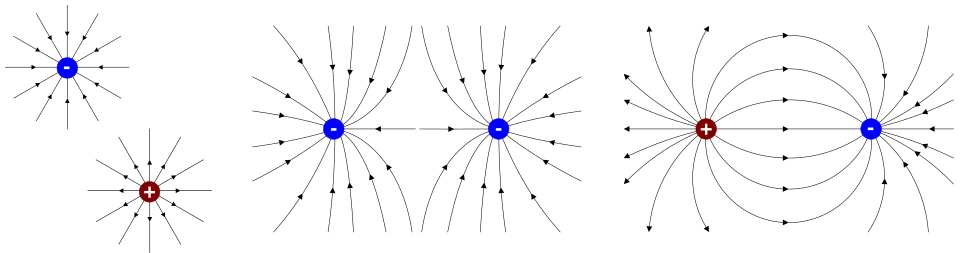 Electric field lines radiating from a positive point charge, showing field strength (density) and direction. (Image: FormulariosBachillerato, CC0, via Wikimedia Commons)
Key Formulas:
Electric field due to a point charge: where is the unit vector pointing away from the charge (for positive ) or toward it (for negative ).
Electric field lines:
- Start on positive charges, end on negative charges (or at infinity).
- Never intersect (each point has one direction).
- Density of lines = strength of the field.
Real-World Example:
- Photocopiers (Xerox machines) use electrostatic attraction to transfer toner (charged particles) onto paper. The drum inside carries a negative charge, attracting positively charged toner particles.
- Nepal’s NTC power lines generate electric fields around high-voltage wires, which must be shielded to prevent interference with electronic devices.
3. Electric Potential & Potential Difference
Electric Potential (V):
The work done per unit charge to bring a test charge from infinity to a point in the field.
- Unit: Volts (V) = Joules/Coulomb (J/C).
- Potential difference (ΔV): Work done per unit charge to move between two points.
Equipotential Surfaces:
- Surfaces where potential is constant.
- Perpendicular to electric field lines.
- No work is done moving a charge along an equipotential surface.
Worked Example (Real-World Tie): In Ncell’s base stations, antennas create electric fields to transmit signals. If a charge is placed 5 m away from a transmitting antenna (modeled as a point charge), calculate:
- The electric field at that point.
- The electric potential at that point.
Solution:
- Electric field:
- Electric potential:
4. Capacitors: Storing Electric Charge
A capacitor is a device that stores electrical energy in an electric field. It consists of two conducting plates separated by an insulating material (dielectric).
Key Formulas:
Capacitance (C): where = charge on one plate, = potential difference between plates.
- Unit: Farad (F) = Coulombs/Volts (C/V).
Capacitance of a parallel-plate capacitor: where = permittivity of free space (), = plate area, = separation distance.
Energy stored in a capacitor:
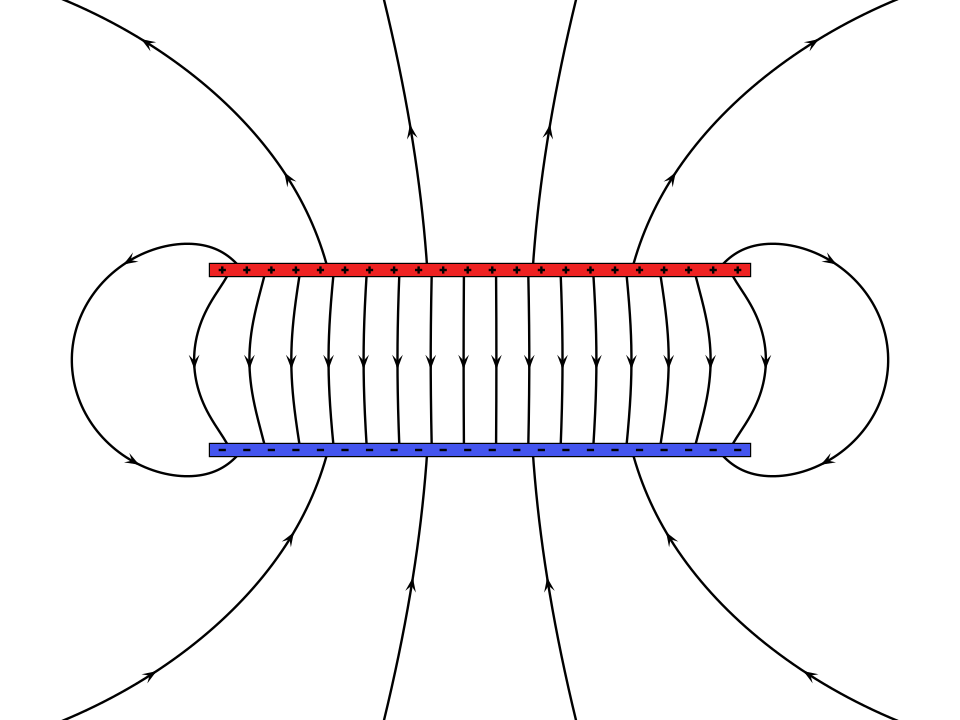 Shows two metal plates with separation , connected to a battery, with electric field lines between them. (Image: Geek3, CC BY-SA 4.0, via Wikimedia Commons)
Types of Capacitors & Their Uses:
| Type | Structure | Applications |
|---|---|---|
| Parallel Plate | Two large flat plates | Filters in power supplies, tuning circuits |
| Cylindrical | Two concentric cylindrical shells | Radio frequency applications |
| Spherical | Two concentric spherical shells | Rare, used in theoretical problems |
| Electrolytic | Aluminum oxide layer + electrolyte | Khalti/eSewa payment gateways (smoothing voltage spikes) |
| Ceramic | Ceramic dielectric between plates | Smartphone touchscreens (capacitive sensing) |
Real-World Example:
- Daraz’s payment processing uses capacitors to stabilize voltage in servers, ensuring smooth transactions.
- Pathao’s GPS systems rely on capacitors in circuits to filter noise and maintain signal integrity.
5. Dielectrics & Their Effect on Capacitance
A dielectric is an insulating material placed between capacitor plates. It:
- Increases capacitance by reducing the electric field between plates.
- Prevents arcing (breakdown of air).
- Stores more energy for the same voltage.
Key Formula: where:
- = capacitance without dielectric,
- = dielectric constant (dimensionless, ).
Common Dielectrics & Their Values:
| Material | Dielectric Constant () | Application |
|---|---|---|
| Vacuum | 1 | Theoretical reference |
| Air | ~1.0006 | General-purpose capacitors |
| Paper | ~3.5 | Old-style capacitors |
| Mica | ~5–7 | High-frequency circuits |
| Glass | ~5–10 | Insulation in high-voltage systems |
| Water | ~80 | Biological systems (cell membranes) |
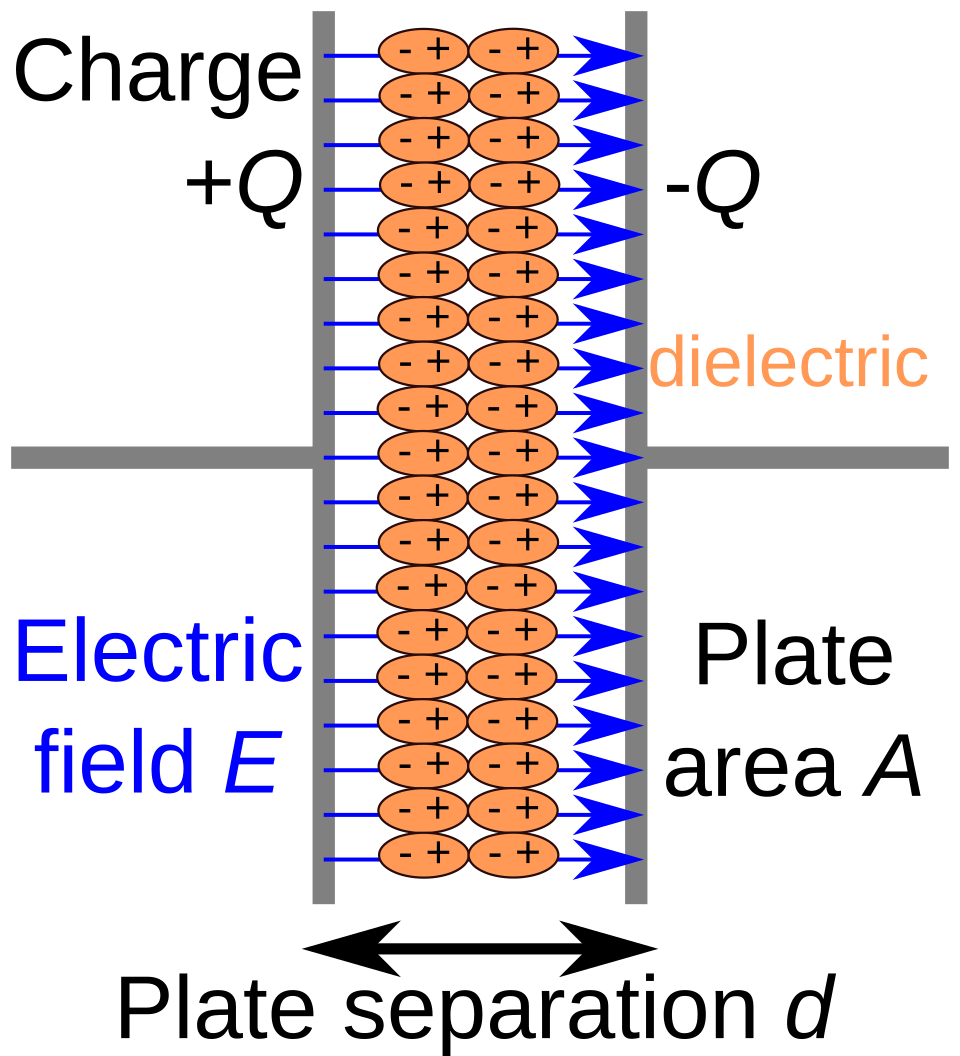 Shows a parallel-plate capacitor with a dielectric slab inserted, reducing the electric field. (Image: Papa November, CC BY-SA 3.0, via Wikimedia Commons)
Worked Example: A parallel-plate capacitor has plates of area separated by . If a dielectric with is inserted, and a battery maintains , find:
- The capacitance without and with the dielectric.
- The charge stored in each case.
Solution:
- Without dielectric (): With dielectric ():
- Charge stored ():
- Without dielectric: .
- With dielectric: .
6. Applications of Electrostatics in Technology
A. Everyday Devices
Photocopiers & Printers
- Use electrostatic attraction to transfer toner (charged particles) onto paper.
- Corona wire charges the drum negatively, attracting positively charged toner.
Air Purifiers & HEPA Filters
- Electrostatic precipitators in air purifiers use charged plates to attract dust particles.
Static Cling in Clothes
- When clothes rub against each other, charge separation occurs, causing attraction (static cling).
B. Modern Electronics
Touchscreens (Smartphones, ATMs)
- Capacitive sensing: Fingers disturb the electric field at the screen’s surface, detecting touch.
RAM (Random Access Memory) in Computers
- Uses capacitors to store bits (0 or 1) as charge states.
Flash Memory (USB Drives, SSDs)
- Relies on charge trapping in floating-gate transistors.
C. Medical Applications
Electrostatic Sprayers
- Used in COVID-19 disinfection (e.g., spraying hospitals with charged droplets for even distribution).
Defibrillators
- Deliver a high-voltage pulse to restart the heart by overriding chaotic electrical signals.
## In the Real World
eSewa & Khalti (Digital Payments)
- Capacitors in payment gateways filter voltage spikes to protect sensitive circuits during transactions.
- Electrostatic discharge (ESD) protection is critical in servers to prevent data corruption.
Nepal’s NTC & Ncell (Power & Telecommunications)
- High-voltage transmission lines create electric fields that must be managed to avoid corona discharge (wasting energy as light/sound).
- Capacitors in substations smooth out voltage fluctuations for stable power supply.
Daraz & Pathao (Logistics & Ride-Hailing)
- GPS systems in delivery vehicles use capacitors to stabilize power for accurate location tracking.
- Static electricity can interfere with sensors; grounding is used to prevent malfunctions.
Nepal Stock Exchange (NEPSE) Data Centers
- Uninterruptible Power Supplies (UPS) use capacitors to provide backup power during outages, ensuring trading systems remain online.
## Exam Tip
What to Focus On:
Coulomb’s Law & Electric Field Calculations
- Always draw a diagram showing charges and distances.
- Remember: Force is a vector—direction matters!
Electric Potential vs. Electric Field
- Potential (V) is a scalar (no direction), while field (E) is a vector.
- Use for non-uniform fields.
Capacitors & Dielectrics
- Parallel-plate formula: (memorize!).
- Dielectric effect: increases by , but voltage drops if battery is disconnected.
Real-World Problem Solving
- eSewa/Khalti: Relate to charge storage in capacitors.
- NTC power lines: Discuss electric field safety and corona discharge.
- Touchscreens: Explain capacitive sensing.
Common Mistakes to Avoid:
- Ignoring units: Always check if answers are in N/C (E), V (V), or F (C).
- Sign errors: Potential is positive for positive charges, but field direction is away from positive charges.
- Assuming uniform fields: Only use for parallel plates or uniform fields.
High-Score Strategies:
- Draw diagrams for every problem (especially electric fields and capacitors).
- Label all variables in equations (examiners reward clarity).
- Relate to real-world examples (e.g., "This is like the capacitor in a smartphone’s touchscreen").
- Show step-by-step calculations—even if the final answer is wrong, partial marks are possible.
## Quick Revision Table
| Concept | Formula | Key Idea |
|---|---|---|
| Coulomb’s Law | Force between two point charges. | |
| Electric Field (Point Charge) | Field strength at a distance . | |
| Electric Potential | Work per unit charge to bring a test charge. | |
| Capacitance (Parallel Plate) | Stores charge . | |
| Dielectric Effect | Increases capacitance by factor . | |
| Energy in Capacitor | Energy stored in electric field. |
Based on the PU BE Computer (PU) syllabus for Applied Physics, unit 5.
Discussion
Loading…