Applied PhysicsUnit 711 min read
Electromagnetic Waves: Nature, Generation, Properties & Applications
Unit 7 of Applied Physics explores how electromagnetic waves propagate, their mathematical foundations, generation mechanisms, and real-world applications from radio to fibre optics, including key concepts like Maxwell’s equations, wave equations, and practical devices like antennas and waveguides.
TAKEAWAYS:
- Electromagnetic waves are transverse oscillations of electric and magnetic fields that propagate at the speed of light .
- Maxwell’s equations unify electricity, magnetism, and light, showing how accelerating charges generate electromagnetic waves.
- The wave equation describes wave propagation in vacuum.
- Antennas (e.g., dipole, parabolic) convert electrical signals into EM waves and vice versa, enabling wireless communication.
- Applications range from radio broadcasting (AM/FM) to medical imaging (MRI) and fibre-optic internet (e.g., NTC’s broadband).
- Polarization and interference phenomena enable technologies like LCD screens and Wi-Fi signal optimization.
1. Introduction to Electromagnetic Waves
Electromagnetic (EM) waves are self-sustaining oscillations of electric and magnetic fields that travel through space at the speed of light. Unlike mechanical waves (e.g., sound), EM waves do not require a medium and can propagate in a vacuum.
Key Characteristics
- Transverse nature: Both and fields oscillate perpendicular to the direction of propagation.
- Speed: in vacuum.
- Energy transport: Carry energy via the Poynting vector .
The Electromagnetic Spectrum
EM waves span a vast range of frequencies and wavelengths, categorized as follows:
| Type | Frequency Range (Hz) | Wavelength Range (m) | Applications |
|---|---|---|---|
| Radio Waves | to | to | AM/FM radio, Wi-Fi, Bluetooth, NTC/Ncell |
| Microwaves | to | to | Microwave ovens, satellite comms, radar |
| Infrared | to | to | Remote controls, thermal imaging, fibre optics |
| Visible Light | to | to | Vision, photography, lasers |
| Ultraviolet | to | to | Sterilization, blacklights, astronomy |
| X-rays | to | to | Medical imaging, security screening |
| Gamma Rays | Cancer treatment, nuclear physics |
2. Maxwell’s Equations and Wave Generation
Electromagnetic waves arise from Maxwell’s four equations, which describe how electric and magnetic fields interact:
- Gauss’s Law for Electricity:
- Gauss’s Law for Magnetism:
- Faraday’s Law of Induction:
- Ampère-Maxwell Law:
Derivation of the Wave Equation: Combining Faraday’s and Ampère-Maxwell’s laws (assuming no charges or currents in vacuum) yields the wave equation for : This shows that electric fields propagate as waves with speed .
How EM Waves Are Generated:
- Accelerating charges: A time-varying current in an antenna produces changing electric and magnetic fields, radiating EM waves.
- Oscillating dipoles: Alternating current in a dipole antenna (e.g., in a radio transmitter) generates EM waves.
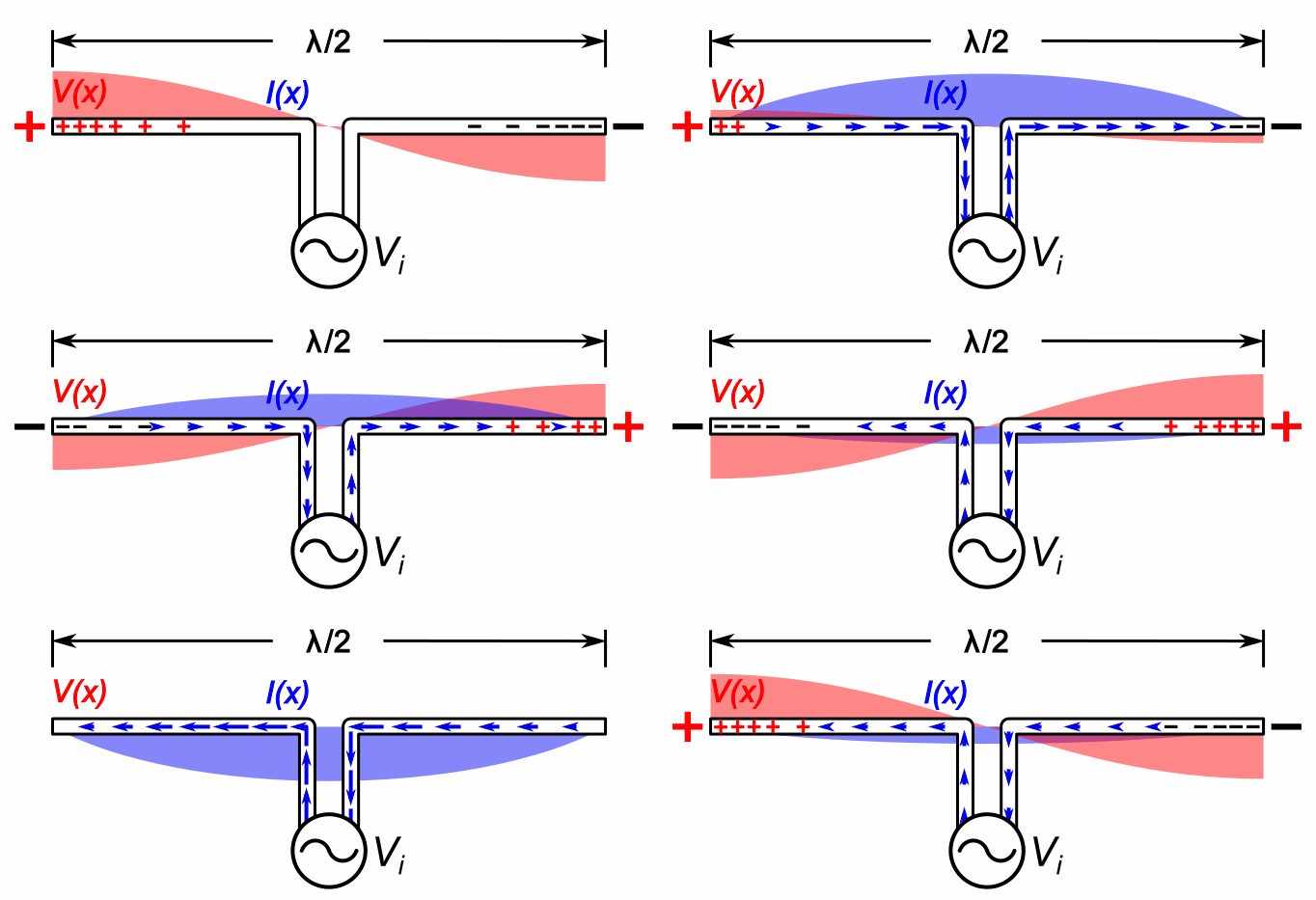 A vertical dipole antenna with alternating current showing how it radiates EM waves in all directions (except along its axis). (Image: Chetvorno, CC0, via Wikimedia Commons)
3. Properties of Electromagnetic Waves
(a) Polarization
Polarization describes the orientation of the oscillating electric field. Linear polarization is common in applications like LCD screens.
Linear Polarization:
- The electric field oscillates in a fixed plane.
- Analyzed using a polarizer (e.g., Polaroid sheet).
Circular/Polarized Waves:
- The electric field rotates as the wave propagates (used in satellite communications).
(b) Interference and Diffraction
- Interference: Superposition of waves can constructively or destructively interfere (e.g., in radio antennas for signal strength).
- Diffraction: Bending of waves around obstacles (e.g., Wi-Fi signal spreading in a room).
(c) Reflection and Refraction
- Reflection: EM waves bounce off surfaces (e.g., radio waves reflecting off ionosphere for long-distance communication).
- Refraction: Waves bend when entering a medium (e.g., fibre optics use total internal reflection).
Mermaid Diagram: Polarization States
stateDiagram-v2
    [*] --> Linear
    Linear --> Circular: Rotation of E-field
    Circular --> Elliptical: Mixed linear + circular
    Elliptical --> [*]
(d) Energy and Intensity
- Intensity (I): Power per unit area, given by: where is the amplitude of the electric field.
4. Antennas and Waveguides
(a) Antennas
Convert electrical signals into EM waves and vice versa. Key types:
- Dipole Antenna: Simple two-wire antenna (used in FM radio).
- Parabolic Antenna: Reflects waves to focus energy (used in satellite dishes).
- Yagi-Uda Antenna: Directional antenna for TV signals.
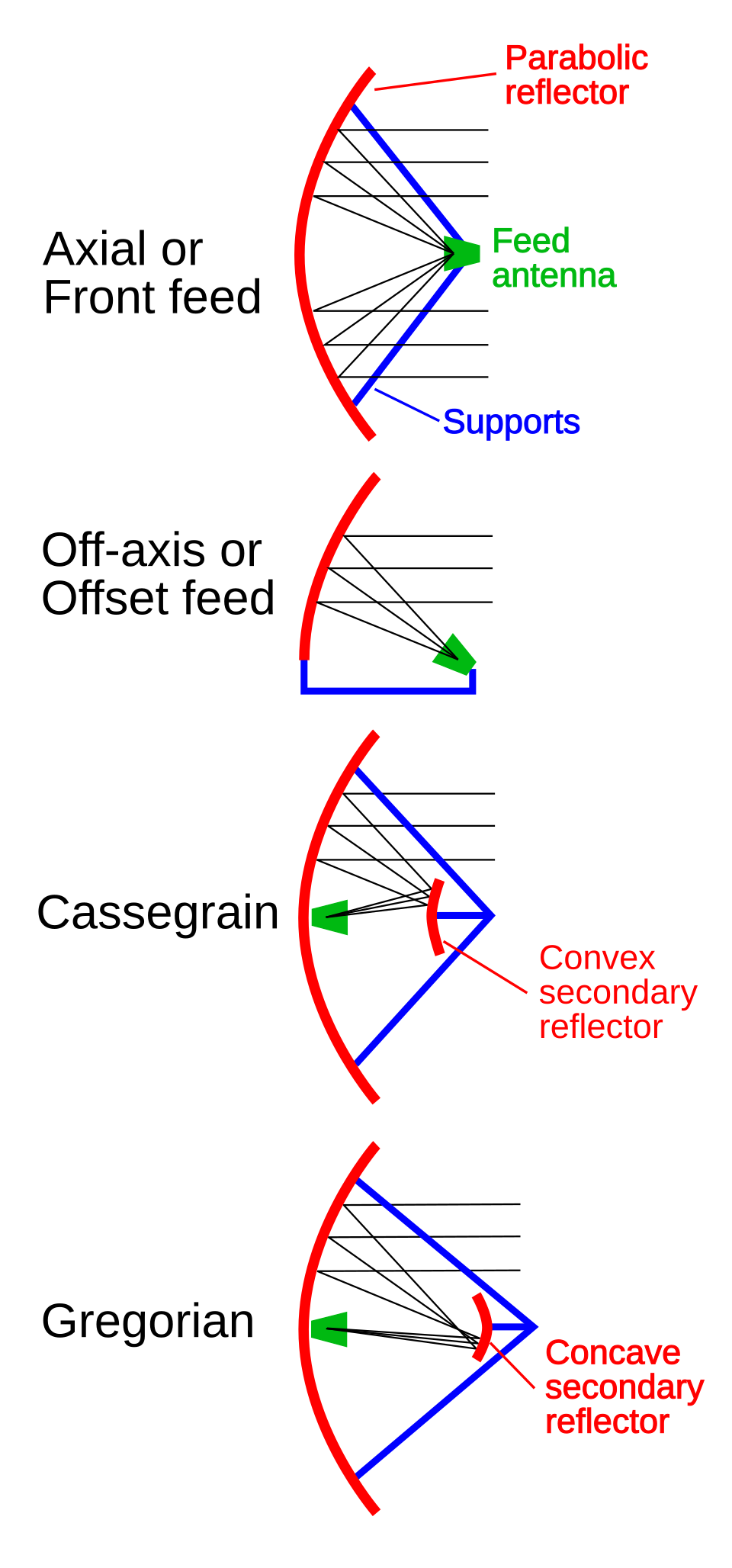 A satellite dish showing how it focuses incoming EM waves onto a receiver. (Image: Chetvorno, Public domain, via Wikimedia Commons)
(b) Waveguides
Conduct EM waves through hollow metal tubes (e.g., in microwave ovens or fibre optics).
5. Applications of Electromagnetic Waves
(a) Communication Technologies
- Radio/Wireless: Ncell uses microwave bands for 4G/5G signals.
- Fibre Optics: NTC’s broadband relies on infrared light in glass fibres.
- Satellite Communication: GPS and weather satellites use microwave bands.
(b) Medical and Industrial Uses
- MRI: Uses radio waves and strong magnetic fields to image internal body structures.
- X-rays: Used in hospitals for bone imaging (e.g., detecting fractures).
(c) Everyday Devices
- Remote Controls: Use infrared waves to send signals to TVs.
- Wi-Fi/Bluetooth: Operate in the microwave band for short-range communication.
6. In the Real World
Ncell’s 4G/5G Networks:
- Uses microwave bands (2.4 GHz–5 GHz) for high-speed data transmission.
- Antennas (e.g., Yagi-Uda) are deployed on towers to radiate signals to phones.
- Polarization is critical to avoid signal interference between adjacent towers.
Daraz’s Order Processing (Logistics):
- While not directly EM waves, Daraz’s barcode scanners use infrared light for reading product codes—an application of EM waves in automation.
- Radio-frequency identification (RFID) tags (operating in the microwave band) track inventory in warehouses.
Kathmandu Traffic Management (Indirect EM Use):
- Traffic lights use visible light (LEDs) to control vehicle flow.
- Emergency vehicle sirens emit sound waves (mechanical waves), but police radios use VHF/UHF radio waves (EM) for coordination.
7. Worked Example: Calculating Wavelength of an FM Radio Signal
Problem: An FM radio station broadcasts at a frequency of . Calculate its wavelength.
Solution:
- Convert frequency to Hz: .
- Use the wave equation , where .
- Rearrange for :
Real-World Tie: Ncell’s 4G base stations operate at frequencies around . Their wavelength is: This short wavelength allows for narrower beams, improving signal focus in urban areas like Kathmandu.
8. Exam Tip
- Maxwell’s Equations: Always recall that Faraday’s Law and Ampère-Maxwell Law are key to deriving the wave equation. Expect questions on their physical meaning (e.g., "Why does a changing magnetic field induce an electric field?").
- Polarization: Distinguish between linear, circular, and elliptical polarization. Draw diagrams to show how a polarizer blocks certain orientations.
- Antennas: Know the difference between omnidirectional (dipole) and directional (parabolic) antennas. Relate to real-world examples like Ncell’s cell towers.
- Wave-Spectrum Applications: Memorize the spectrum table and match frequencies to devices (e.g., "What band does a microwave oven use?" → 2.45 GHz microwave).
- Calculations: Practice problems involving , intensity , and Poynting vector. Show units clearly (e.g., , ).
- Diagrams: Always include ray diagrams for reflection/refraction and polarization states. Label axes (e.g., -field direction, propagation direction).
Common Pitfalls:
- Confusing speed of light in vacuum () with speed in a medium (e.g., glass slows light to , where is refractive index).
- Forgetting that EM waves are transverse—mechanical waves (e.g., sound) are longitudinal.
- Mixing up frequency and wavelength: Higher frequency = shorter wavelength (e.g., gamma rays vs. radio waves).
Based on the PU BE Computer (PU) syllabus for Applied Physics, unit 7.
Discussion
Loading…