Applied PhysicsUnit 811 min read
Quantum Physics: Particles, Waves, and Energy Levels
Unit 8 of Applied Physics explores the fundamental principles of quantum mechanics, including wave-particle duality, quantization of energy, the photoelectric effect, Bohr’s atomic model, and quantum tunneling, with real-world applications in technology and everyday life.
Core Concepts of Quantum Physics
1. Wave-Particle Duality
Quantum physics introduces the revolutionary idea that particles (like electrons) and waves (like light) exhibit dual nature: they can behave as both particles and waves under different conditions.
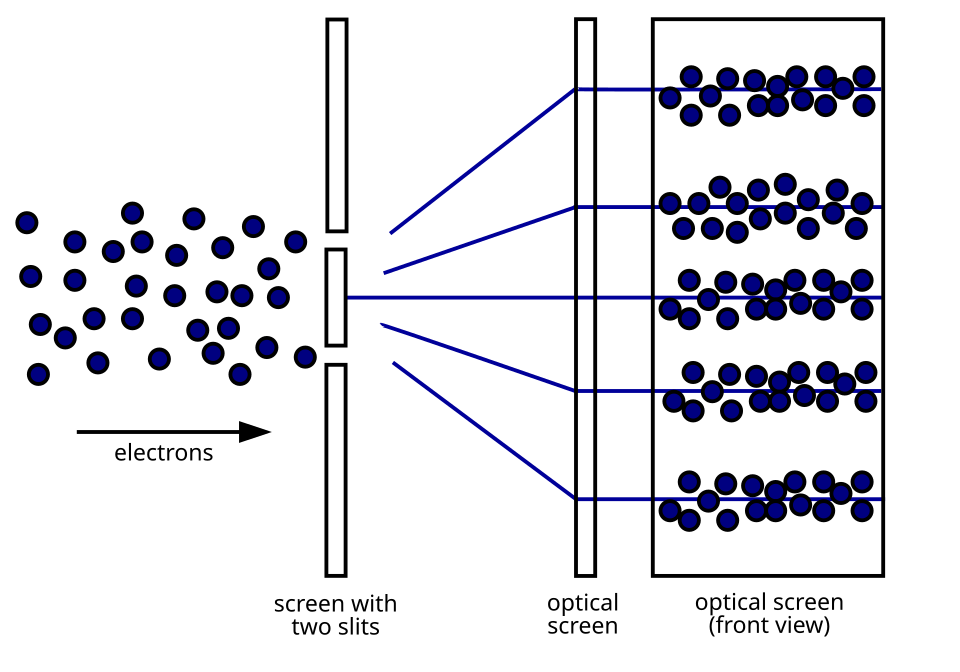 Electron diffraction pattern proving matter-wave duality (de Broglie’s hypothesis). (Image: inductiveload, Public domain, via Wikimedia Commons)
Key Observations:
- Light as a Wave: Interference and diffraction patterns (e.g., Young’s double-slit experiment) prove light behaves as a wave.
- Light as a Particle: The photoelectric effect (Einstein, 1905) shows light behaves as discrete packets of energy called photons.
- Matter as a Wave: De Broglie’s hypothesis () states that particles (e.g., electrons) have wave-like properties.
Real-World Example: Photoelectric Effect in Solar Panels
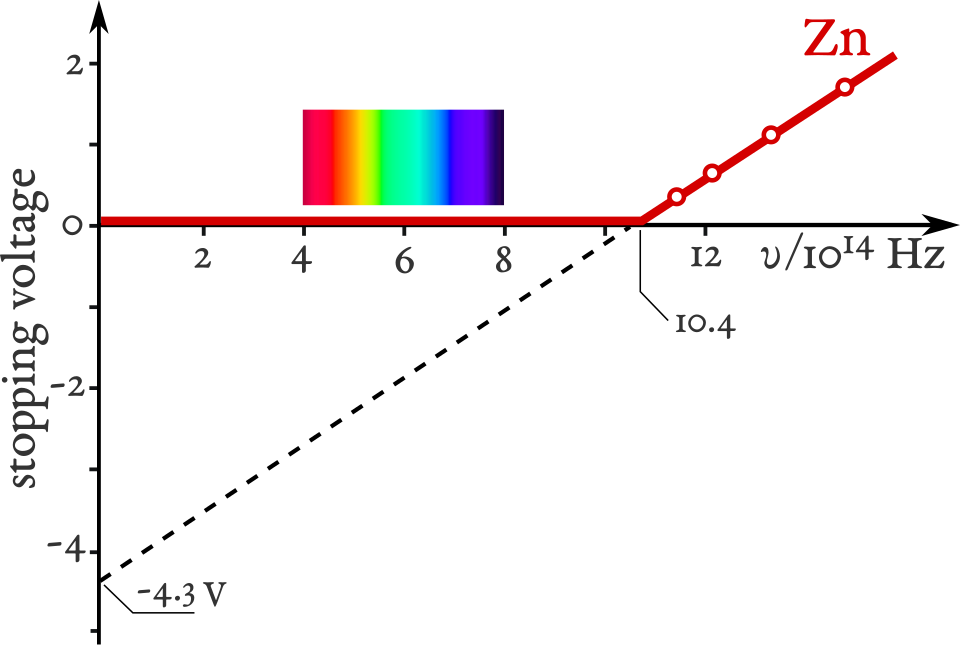 Shows how light energy ejects electrons from a metal surface, used in solar cells. (Image: Ponor, CC BY-SA 4.0, via Wikimedia Commons)
- How it works: When sunlight (photons) hits a solar panel, electrons are ejected if photon energy exceeds the work function () of the material.
- Application: Solar panels (e.g., used in Nepal’s rural electrification projects) convert sunlight into electricity using this principle.
Worked Example: Calculating Threshold Frequency
A metal has a work function . What is the threshold frequency ()?
2. Quantization of Energy
Energy is not continuous but exists in discrete packets called quanta. This was first observed in blackbody radiation and later explained by Planck’s law.
Planck’s Quantum Hypothesis
- Energy of a photon: , where (Planck’s constant).
- Blackbody Radiation: Explains why hot objects emit light at specific frequencies (e.g., a glowing filament in a bulb).
Real-World Example: LED Lights
- How it works: Electrons in an LED jump from a higher energy level to a lower one, emitting a photon of specific wavelength (color).
- Application: Energy-efficient LEDs (used in Nepal’s streetlights) rely on quantum energy jumps.
3. Bohr’s Model of the Hydrogen Atom
Niels Bohr proposed that electrons orbit the nucleus in discrete energy levels (quantized orbits), explaining atomic spectra.
Key Postulates:
- Electrons move in stable orbits without radiating energy.
- Energy levels are quantized: .
- Electrons emit/absorb photons when transitioning between levels: .
Worked Example: Hydrogen Emission Spectrum
Calculate the wavelength of light emitted when an electron drops from to .
Real-World Example: Neon Signs
- How it works: Electric discharge excites electrons in neon gas, causing them to jump to higher energy levels. When they return, they emit photons of specific wavelengths (e.g., red-orange light in signs).
4. Quantum Tunneling
Particles can pass through energy barriers even if their energy is less than the barrier’s height, a phenomenon critical in scanning tunneling microscopes (STM) and semiconductor devices.
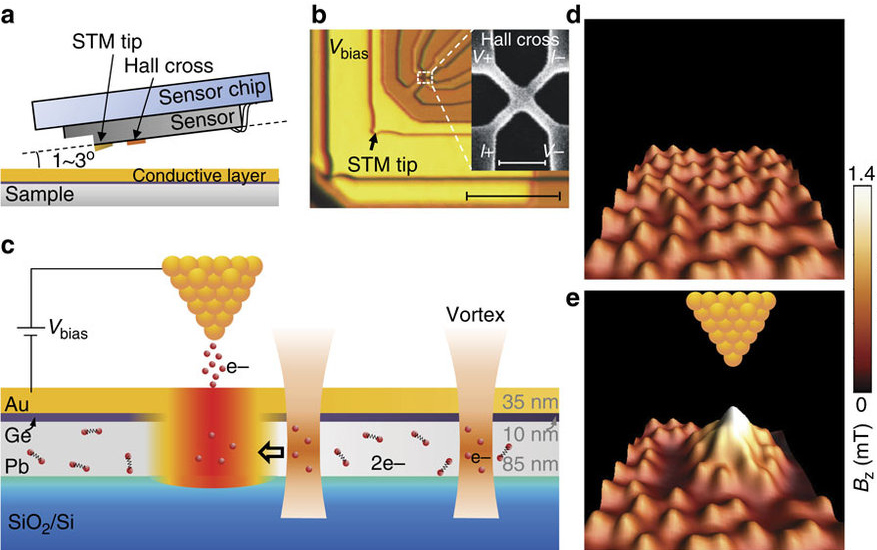 STM tip detecting tunneling electrons to map atomic surfaces (resolution: ~0.1 nm). (Image: Jun-Yi Ge, Vladimir N. Gladilin, Jacques Tempere, Cun Xue, J, CC BY 4.0, via Wikimedia Commons)
How It Works:
- Probability of tunneling depends on barrier height and width.
- Application: STM (used in nanotechnology) scans surfaces by detecting tunneling electrons.
Real-World Example: Flash Memory (USB Drives)
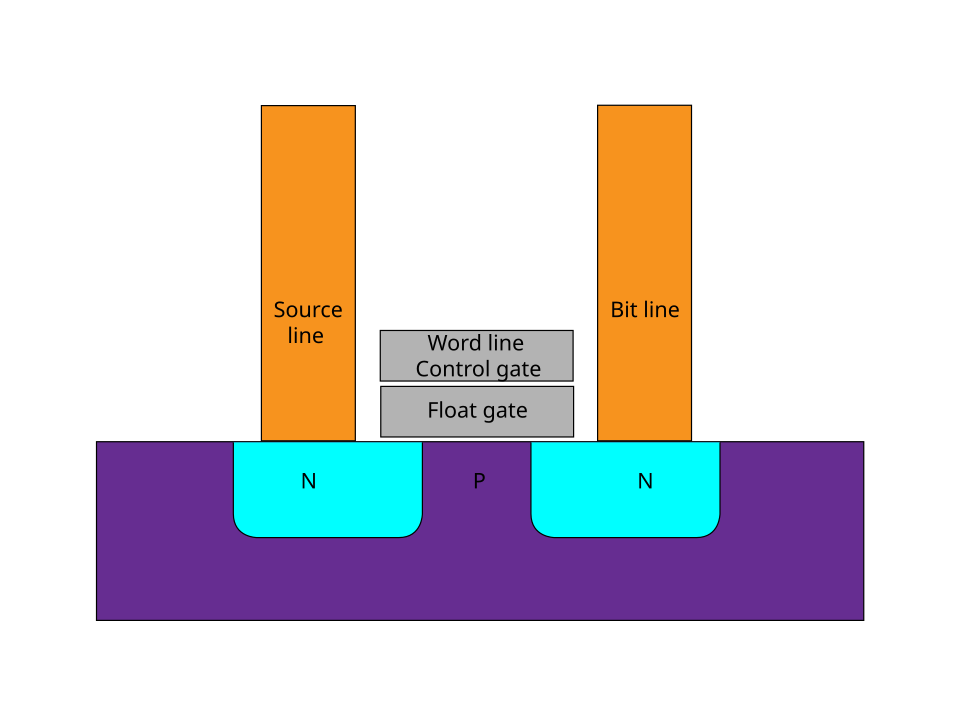 Shows how electrons tunnel through oxide layers to store data. (Image: Cyferz at English Wikipedia, CC BY 2.5, via Wikimedia Commons)
- How it works: Electrons tunnel through a thin oxide layer in a floating-gate transistor, storing data as charge states.
- Application: USB drives and SSDs rely on quantum tunneling for data retention.
5. Heisenberg’s Uncertainty Principle
It is impossible to simultaneously measure a particle’s position () and momentum () with absolute precision:
Implications:
- Explains why electrons in atoms cannot have exact orbits (contradicting Bohr’s model).
- Fundamental limit in quantum computing and electron microscopy.
Real-World Example: Electron Microscopes
- How it works: Electrons are accelerated to high speeds, but their position and momentum cannot be precisely known, limiting resolution.
6. Wavefunctions and Probability
The Schrödinger equation describes how quantum systems evolve. The wavefunction () gives the probability of finding a particle in a region.
Key Ideas:
- Probability Density: gives the likelihood of a particle’s position.
- Superposition: A particle can exist in multiple states at once (e.g., Schrödinger’s cat).
Real-World Example: Quantum Dots in Displays
- How it works: Quantum dots confine electrons in tiny spaces, forcing them into discrete energy levels. When excited, they emit light of exact wavelengths (used in high-definition TVs like Samsung QLED).
Comparison Table: Classical vs. Quantum Physics
| Property | Classical Physics | Quantum Physics |
|---|---|---|
| Nature of Light | Wave only | Wave-particle duality |
| Energy Levels | Continuous | Quantized (discrete) |
| Particle Behavior | Deterministic | Probabilistic (wavefunction) |
| Measurement Limits | Precise position and momentum possible | Heisenberg’s uncertainty principle |
| Applications | Macroscopic systems (e.g., mechanics) | Atomic/nanoscale (e.g., semiconductors) |
In the Real World
eSewa & Khalti (Digital Payments)
- Quantum Encryption: Future banking apps may use quantum key distribution (QKD) for unhackable transactions, leveraging quantum superposition to detect eavesdropping.
Ncell & NTC (Telecom Infrastructure)
- Fiber Optics: Quantum principles enable low-loss data transmission in optical fibers (used in Nepal’s expanding broadband networks). Light pulses (photons) travel as waves but are detected as particles.
Pathao (Ride-Hailing App)
- GPS & Quantum Sensors: Future autonomous vehicles may use quantum accelerometers (more precise than classical ones) for navigation, reducing errors in traffic routing.
NEPSE (Stock Market)
- Quantum Computing: Financial institutions use quantum algorithms to optimize stock portfolios faster than classical computers (e.g., predicting market trends via superposition).
Exam Tip
Memorize Key Equations:
- Photoelectric effect:
- Bohr’s energy levels:
- De Broglie wavelength:
- Heisenberg’s uncertainty:
Understand Real-World Applications:
- Solar panels (photoelectric effect)
- LEDs/Neon signs (energy levels)
- Flash memory (quantum tunneling)
- Electron microscopes (uncertainty principle)
Diagram-Based Questions:
- Always draw energy level diagrams for atomic transitions.
- Sketch wave-particle duality experiments (e.g., double-slit for electrons).
- Label quantum tunneling in semiconductor devices.
Common Pitfalls:
- Don’t confuse classical waves (e.g., sound) with quantum waves (e.g., electron wavefunctions).
- Remember: Photons have momentum () but no mass.
- Bohr’s model only works for hydrogen (not multi-electron atoms).
Final Note: Quantum physics is abstract but essential for modern tech. Focus on concepts over memorization—examiners test your ability to apply these ideas (e.g., calculating wavelengths, explaining devices). Practice numerical problems and diagram-based questions!
In the real world
Solar Panels (eSewa, Khalti, NTC): Use the photoelectric effect (wave-particle duality) to convert sunlight into electricity. When photons (light particles) hit silicon cells, they eject electrons, creating a current. Nepal’s off-grid solar systems (e.g., in rural areas like Dolakha) rely on this principle to power homes and charge devices.
Flash Memory (USB Drives, SSDs): Quantum tunneling enables data storage in floating-gate transistors. Electrons tunnel through thin oxide layers to store bits (0s/1s) as charge states. Brands like SanDisk and Kingston use this in USB drives and laptops sold in Nepal.
Quantum Dots in TVs (Samsung QLED): Discrete energy levels in quantum dots (nanoscale semiconductors) produce pure colors. Nepal’s urban households use QLED TVs (e.g., in Thapathali or Lakshmi Path) for sharper images, thanks to precise light emission controlled by quantum mechanics.
Based on the PU BE Computer (PU) syllabus for Applied Physics, unit 8.
Discussion
Loading…