Computer NetworksUnit 310 min read
Physical Layer: Signals, Media, Modulation & Ethernet
Unit 3 of Computer Networks explores the Physical Layer (Layer 1)—the foundation of all networks. This note covers signaling techniques, transmission media (copper, fiber, wireless), modulation schemes (AM, FM, digital), Gigabit Ethernet (full/half duplex, CSMA/CD, 1000BASE-T), and real-world implementations like NTC’s
TAKEAWAYS:
- The Physical Layer transmits raw bits as signals (electrical, optical, or wireless) over media, defining bit rate, bandwidth, and modulation.
- Guided media (twisted pair, coaxial, fiber) vs. unguided media (wireless) differ in speed, cost, and interference susceptibility.
- Gigabit Ethernet (1000BASE-T) uses full-duplex (simultaneous TX/RX) and half-duplex (CSMA/CD) modes, with Manchester encoding for clock synchronization.
- Modulation (ASK, FSK, PSK) converts digital bits to analog signals for transmission over bandwidth-limited channels.
- Real-world applications: NTC’s fiber-optic backbone (high-speed data), Ncell’s 4G towers (wireless modulation), and eSewa’s payment servers (Ethernet redundancy).
- Exam focus: Compare media types, explain Gigabit Ethernet parameters, and calculate bandwidth/throughput for given scenarios.
1. Role of the Physical Layer
The Physical Layer is the lowest layer in the OSI model, responsible for:
- Transmitting raw bits (0s and 1s) over a physical medium.
- Defining electrical/optical/mechanical characteristics (e.g., voltage levels, light pulses, radio frequencies).
- Modulation/demodulation (converting bits to signals and vice versa).
- Bit synchronization (ensuring sender/receiver clocks align).
2. Transmission Media: Guided vs. Unguided
Media are classified into guided (wired) and unguided (wireless), each with trade-offs in speed, cost, and interference.
A. Guided Media
| Type | Description | Pros | Cons | Example Use Case |
|---|---|---|---|---|
| Twisted Pair | Copper wires twisted to reduce crosstalk. | Cheap, easy to install. | Susceptible to EMI, limited speed. | Ncell’s DSL lines, office Ethernet. |
| Coaxial Cable | Copper core + shielding (used in old Ethernet and cable TV). | Higher bandwidth than TP. | Bulky, expensive. | NTC’s legacy broadband. |
| Fiber Optic | Glass/plastic fibers transmitting light pulses. | High speed, immune to EMI, secure. | Expensive, fragile. | NTC’s fiber backbone, Daraz data centers. |
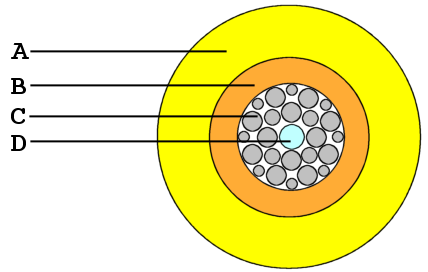 Labelled diagram showing cladding, core, and light propagation. (Image: J.P.Lon at English Wikipedia, CC BY 2.5, via Openverse)
B. Unguided Media (Wireless)
- Radio Waves: Used in Wi-Fi (2.4 GHz/5 GHz), Bluetooth, and 4G/5G.
- Microwaves: Satellite communication (e.g., Ncell’s backhaul).
- Infrared: Short-range (e.g., TV remotes).
Comparison Table:
| Media | Speed | Cost | Interference | Use Case |
|---|---|---|---|---|
| Twisted Pair | 10 Mbps–10 Gbps | Low | High (EMI) | Ethernet (1000BASE-T) |
| Fiber Optic | 10 Gbps–100 Tbps | High | None | NTC’s backbone, ISPs |
| Wireless (4G) | 10–100 Mbps | Medium | Medium (signal loss) | Ncell, Pathao’s ride-hailing GPS |
3. Signaling Techniques
A. Analog vs. Digital Signals
- Analog: Continuous waveform (e.g., human voice, AM radio).
- Digital: Discrete pulses (0s and 1s, e.g., Ethernet frames).
B. Modulation Schemes
Digital data must be modulated to transmit over analog channels (e.g., radio waves). Common techniques:
- Amplitude Modulation (AM): Vary signal amplitude (e.g., old radio broadcasts).
- Frequency Modulation (FM): Vary frequency (e.g., FM radio).
- Phase Shift Keying (PSK): Encode bits in phase changes (used in Wi-Fi, 4G).
- Quadrature Amplitude Modulation (QAM): Combine amplitude/phase (used in cable TV, DSL).
Worked Example: Calculating Bandwidth for a Daraz Data Center
- Daraz’s server sends 10 Gbps over 1000BASE-T Ethernet (copper twisted pair).
- Bandwidth required = Bit rate × (1 + overhead).
- Overhead for Ethernet ≈ 20% (preamble, CRC, etc.).
- Total bandwidth = 10 Gbps × 1.2 = 12 Gbps.
- Fiber optic would handle this easily, but copper (Cat 6/7) is limited to ~10 Gbps over short distances.
4. Gigabit Ethernet (1000BASE-T)
Gigabit Ethernet is a Physical Layer standard for 1 Gbps data transfer. Key parameters:
A. Topology
- Star topology: All devices connect to a central switch (common in offices/data centers).
- Bus topology: Legacy (e.g., old Ethernet 10BASE2).
graph TD
    subgraph Star Topology
        A["Central Switch"]
        B["PC 1"]
        C["PC 2"]
        D["Server"]
    end
    A --> B
    A --> C
    A --> D
    subgraph Bus Topology
        E["Bus Line"]
        F["Device 1"]
        G["Device 2"]
    end
    E --> F
    E --> G
B. Duplex Modes
| Mode | Description | Collision Handling | Use Case |
|---|---|---|---|
| Half-Duplex | Devices take turns transmitting (like a walkie-talkie). | Uses CSMA/CD (Carrier Sense Multiple Access with Collision Detection). | Legacy Ethernet (10BASE-T). |
| Full-Duplex | Devices transmit and receive simultaneously (like a phone call). | No collisions (switch buffers traffic). | Modern Ethernet (1000BASE-T). |
Worked Example: NTC’s Fiber Backbone
- NTC uses full-duplex fiber for its backbone to avoid collisions and achieve 100 Gbps+ speeds.
- Half-duplex would cause packet loss due to collisions on high-traffic links.
C. Encoding: Manchester Encoding
- Problem: How to synchronize clocks between sender/receiver?
- Solution: Manchester encoding encodes each bit as a transition (e.g.,
0= low→high,1= high→low).- Ensures clock recovery (no need for separate clock signals).
- Double the bandwidth (1 bit = 2 signal changes).
D. CSMA/CD (Half-Duplex Only)
- Carrier Sense: Check if the medium is idle.
- Transmit: If idle, send data.
- Collision Detection: If two devices transmit simultaneously, a collision occurs.
- Both devices send a jam signal and back off (exponential delay).
- Retry: Devices wait a random time before retransmitting.
Mermaid Sequence for CSMA/CD Collision:
sequenceDiagram
    participant A as Device A
    participant B as Device B
    participant Medium

    A->>Medium: Sends data (senses idle)
    B->>Medium: Sends data (senses idle)
    Medium-->>A: Collision detected (jam signal)
    Medium-->>B: Collision detected (jam signal)
    A->>A: Back off (random delay)
    B->>B: Back off (random delay)
    A->>Medium: Retransmits
5. Real-World Applications
A. NTC’s Fiber-Optic Backbone
- Idea Used: Fiber optic transmission (high bandwidth, low latency).
- How: NTC uses dense wavelength-division multiplexing (DWDM) to send multiple data streams over a single fiber.
- Impact: Enables high-speed internet for Nepal’s cities.
B. Ncell’s 4G Towers
- Idea Used: Wireless modulation (OFDM) and frequency reuse.
- How: Towers use multiple antennas (MIMO) to increase data rates (up to 1 Gbps).
- Impact: Powers Pathao’s real-time GPS tracking and eSewa’s mobile payments.
C. eSewa’s Payment Servers
- Idea Used: Redundant Ethernet links (full-duplex) for failover.
- How: If one 1000BASE-T link fails, traffic switches to a backup link.
- Impact: Zero downtime during peak transaction hours.
6. Common Drawbacks and Solutions
| Drawback | Cause | Solution |
|---|---|---|
| Signal Attenuation | Distance, interference. | Use repeaters/amplifiers or fiber. |
| Electromagnetic Interference (EMI) | Power lines, other signals. | Shielded twisted pair (STP) or fiber. |
| Bandwidth Limitations | Copper’s speed cap (~10 Gbps). | Upgrade to fiber or higher-category cables (Cat 6a, Cat 7). |
| Collision in Half-Duplex | Multiple devices transmitting. | Switch to full-duplex or CSMA/CD. |
7. Exam Tip: How to Score Full Marks
For Gigabit Ethernet (1000BASE-T):
- Must mention: Full/half-duplex, CSMA/CD, Manchester encoding, star topology, and 1000BASE-TX (Cat 5e+ cables).
- Example: "In full-duplex mode, collisions are avoided because the switch buffers traffic, unlike half-duplex where CSMA/CD is used."
For Media Comparison:
- Use a table (as above) and highlight trade-offs (e.g., fiber vs. copper).
- Example: "Fiber is immune to EMI but expensive; twisted pair is cheap but limited to 100 m."
For Modulation:
- Explain how AM/FM/PSK encode bits and give a real-world example (e.g., FM radio uses FM modulation).
For Worked Examples:
- Always show calculations (e.g., bandwidth = bit rate × overhead).
- Relate to Nepal: "NTC’s fiber uses DWDM to multiplex 80 channels, increasing capacity."
Diagrams:
- Draw:
- OSI Layer 1 position.
- Ethernet star topology.
- Manchester encoding waveform.
- CSMA/CD collision sequence.
- Draw:
Based on the PU BE Computer (PU) syllabus for Computer Networks, unit 3.
Discussion
Loading…