Food Production and Patisserie IIUnit 310 min read
Meat Cookery: Cuts, Methods, Safety & Flavor Science
Unit 3 of Food Production and Patisserie II explores the anatomy of meat cuts, professional cooking techniques (grilling, braising, roasting), safety protocols for handling meat, and how to balance flavor, texture, and presentation in hotel kitchens—with real-world examples from Nepali restaurants and global chains.
TAKEAWAYS:
- Meat anatomy matters: Prime cuts (loin, rib, leg) yield tender meat, while connective-tissue-rich cuts (shank, brisket) need slow cooking to break down collagen.
- Cooking methods transform texture: Dry heat (grilling, roasting) sears proteins for crispiness, while moist heat (braising, stewing) tenderizes tough cuts.
- Safety is non-negotiable: Cross-contamination, temperature control (74°C for poultry, 63°C for beef), and proper storage (≤4°C) prevent foodborne illnesses.
- Flavor science: Maillard reaction (browning) and caramelization create depth; acid (vinegar, wine) and fat (butter, oil) enhance taste.
- Nepali adaptations: Slow-cooked thukpa meat uses tough cuts, while choila relies on marinades to tenderize and add aroma.
- Waste reduction: Offal (liver, kidneys) and bones can be repurposed into stocks, sauces, or patties.
1. Meat Anatomy and Cuts: From Butcher Block to Kitchen
Meat’s structure determines tenderness, cooking time, and cost. Cuts are classified by:
- Muscle type: Prime cuts (e.g., tenderloin) have less connective tissue; working muscles (e.g., shank) need slow cooking.
- Fat marbling: Intramuscular fat (e.g., ribeye) adds flavor and juiciness.
- Bone-in vs. boneless: Bones (e.g., beef short ribs) add flavor but require longer cooking.
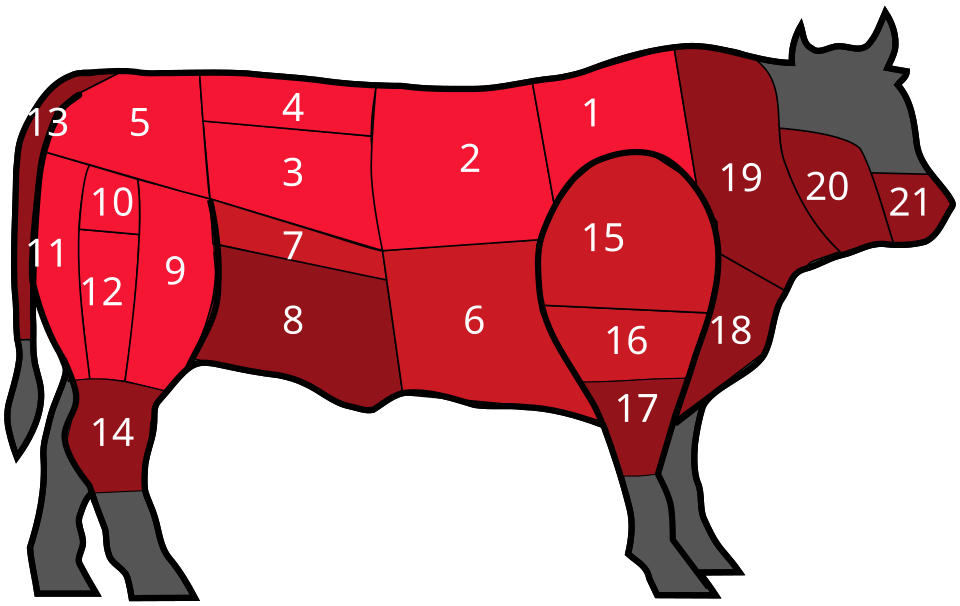 A butcher’s guide to global cuts (beef, lamb, pork), highlighting Nepali favorites like goat leg and buffalo shank. (Image: Beef cuts France.svg: Pethrus derivative work: Josugoni (tal, CC BY-SA 3.0, via Wikimedia Commons)
Worked Example: Choosing Cuts for a Nepali Thali
- Customer demand: A thali requires 3–4 types of meat (chicken, mutton, beef, pork).
- Budget constraint: Use 70% tough cuts (shank, neck) for slow-cooked dishes (choila, dhindo) and 30% prime cuts (chicken breast, lamb loin) for grilled items.
- Prep time: Tough cuts marinate overnight in yogurt + spices (turmeric, cumin) to tenderize via enzymatic action (papain in yogurt breaks down collagen).
2. Cooking Methods: Science Behind the Heat
Each method targets specific textures and flavors. Compare dry vs. moist heat:
| Method | Heat Source | Best For | Key Technique | Nepali Example |
|---|---|---|---|---|
| Grilling | Direct dry heat (charcoal/gas) | Prime cuts (chicken breast, lamb chops) | High heat (200–260°C), 3–5 mins per side | Tandoori chicken (marinated, skewered) |
| Roasting | Oven (convection/radiant) | Large cuts (whole leg, rib) | 150–180°C, 20–60 mins (rest 10–15 mins) | Beef roast (slow-cooked with spices) |
| Braising | Moist heat (liquid + lid) | Tough cuts (brisket, pork shoulder) | Simmer 2–4 hours at 90–100°C | Mutton curry (pressure cooker) |
| Stewing | Boiling (long simmer) | Extremely tough (oxtail, tripe) | 3–6 hours, 80–90°C | Gundruk ko chatamari (fermented leafy greens + meat) |
| Poaching | Gentle liquid (water/broth) | Delicate cuts (fish, chicken breast) | 70–85°C, 10–20 mins | Poached eggs (for sandwiches) |
| Pan-Searing | High-fat pan (butter/oil) | Thin cuts (steak, pork chops) | 2–3 mins per side, then rest | Bhutanese ema datshi (pork strips) |
Why Moist Heat Wins for Tough Cuts
- Collagen breakdown: Heat (60–90°C) converts collagen → gelatin, making meat tender.
- Example: Buffalo shank braised for 4 hours in tarkari (vegetable) gravy becomes fork-tender.
- Science: Collagen fibers align parallel to muscle; slow cooking disrupts this alignment.
3. Safety Protocols: Preventing Foodborne Illness
Meat is a high-risk item for Salmonella, E. coli, and Listeria. Follow the 4 Cs:
- Clean: Wash hands (20 sec with soap), surfaces, and utensils between raw meat and ready-to-eat foods.
- IMAGE: handwashing steps labelled diagram | Proper technique: palms, between fingers, under nails.
- Chill: Store meat at ≤4°C (refrigerator) or ≤–18°C (freezer). Thaw in fridge, not at room temperature.
- Danger zone: 5–60°C is where bacteria multiply rapidly.
- Cook: Use a meat thermometer to verify core temperatures:
- Beef/pork: 63°C (medium)
- Poultry: 74°C (no pink)
- Ground meat: 71°C (higher surface area = more bacteria).
- Cross-contamination: Use separate cutting boards (color-code: red for meat, green for veggies).
Real-World Failure: Pathao’s Food Delivery Safety
- Problem: In 2022, Pathao faced complaints of undercooked meat deliveries due to:
- Drivers not using insulated bags (meat stayed in "danger zone" during transit).
- No temperature checks at pickup.
- Solution: Pathao now partners with hotel management-trained delivery agents who:
- Carry digital thermometers to verify meat temps.
- Use pre-chilled insulated boxes (keeps meat ≤10°C for 2 hours).
4. Flavor Enhancement: The Nepali Chef’s Toolkit
Nepali cuisine balances five tastes (panchratna): sweet, sour, salty, bitter, and pungent. Techniques:
- Marinades: Acid (lemon, yogurt) tenderizes and adds tang; spices (cumin, coriander) infuse flavor.
- Example: Goat leg marinated in mustard oil + garlic for 12 hours before grilling.
- Basting: Brush meat with melted butter or oil during roasting to retain moisture and add flavor.
- Reduction sauces: Simmering tarkari gravy reduces liquid, intensifying umami (MSG-like compounds).
- Offal magic: Liver (high in iron) and kidneys (meaty texture) are rehydrated in milk + spices before cooking.
Worked Example: Daraz’s "Hotel-Style" Meat Orders
- Customer order: "Medium-rare lamb chops with mint chutney."
- Chef’s steps:
- Dry brine: Salt chops 12 hours before cooking to season deeply.
- Sear: 2 mins per side in clarified butter (ghee) at 220°C.
- Rest: 5 mins to redistribute juices (prevents dry meat).
- Serve: Pair with raita (yogurt + cucumber) to cool the palate.
5. Waste Reduction: From Bones to Stocks
Nepali kitchens waste 30–40% of meat as offal or trimmings. Repurpose:
- Bones: Simmer for 6–8 hours to make clear stock (for soups) or dark stock (for gravies).
- Ratio: 1 kg bones + 4L water + aromatics (onion, celery, bay leaf).
- Fat: Render into dripping (for roasting potatoes) or suet (for puddings).
- Offal: Liver → patties; kidneys → stew; blood → black pudding (popular in Newari cuisine).
6. Exam Tip: How to Score Full Marks
- Diagrams > Text: Always draw a labeled flow of meat from butcher to plate (include storage, prep, cooking, service).
- Compare methods: Use a table (like above) to contrast grilling vs. braising for a specific cut (e.g., pork shoulder).
- Nepali context: Relate answers to local dishes:
- "Braising is ideal for dhindo because the slow cook breaks down collagen in goat shank."
- Science keywords: Use terms like:
- Maillard reaction, collagen → gelatin, enzymatic tenderization, cross-contamination.
- Calculation questions: Practice temperature conversions (e.g., "Convert 160°F to Celsius for poultry safety").
In the Real World
Khalti’s "Hotel Meal" Service
- Idea Used: Temperature control and cross-contamination.
- How: Khalti partners with hotel-trained cooks who:
- Use separate prep areas for raw meat vs. cooked food.
- Deliver meals in insulated containers with gel packs to maintain ≥60°C for 1 hour.
- Example: A beef biryani order stays safe because rice and meat are cooked separately, then combined at the delivery point.
NTC’s Catering for Railway Dining Cars
- Idea Used: Batch cooking and holding temperatures.
- How: NTC’s kitchen in Bharatpur pre-cooks meat in large batches, then:
- Chills rapidly to 10°C within 90 mins (using blast chillers).
- Reheats to 74°C before serving to ensure safety.
- Nepali twist: Uses jwano (fermented soybean) in stews to add umami without overpowering local tastes.
Daraz’s "Prime vs. Economy" Meat Cuts
- Idea Used: Cut selection for cooking methods.
- How: Daraz’s "Restaurant Menu" labels cuts with icons:
- 🔥 = Grill-friendly (chicken breast, lamb chops).
- 🍲 = Braise/stew (brisket, pork belly).
- Example: A customer ordering beef stir-fry gets sirloin strips (tender, quick-cooking), while beef curry uses chuck roast (cheaper, slow-cooked).
Final Visual Summary
Based on the TU BHM syllabus for Food Production and Patisserie II (BHM302), unit 3.
Discussion
Loading…