Food Production and Patisserie IIUnit 46 min read
Poultry & Game: Cookery, Cuts, Hygiene & Menu Applications
Unit 4 of Food Production and Patisserie II covers poultry (chicken, duck, turkey) and game (quail, rabbit, venison) preparation techniques, hygienic handling, cuts, cooking methods, and their role in hotel menus—with real-world examples from Nepali restaurants and global brands.
Key Definitions and Classification
Poultry vs. Game
Poultry refers to domesticated birds raised for food (e.g., chicken, duck, turkey, goose), while game includes wild or farmed non-domestic animals (e.g., rabbit, quail, venison, pheasant). The distinction matters for cooking methods, seasoning, and menu pricing.
classDiagram
    class Poultry {
        +Domesticated birds
        +Examples: Chicken, Duck, Turkey
        +Cooking: Roasting, Braising, Frying
    }
    class Game {
        +Wild or farmed non-birds
        +Examples: Rabbit, Quail, Venison
        +Cooking: Roasting, Stewing, Grilling
    }
    Poultry --> "Uses" MenuItem
    Game --> "Uses" MenuItem
Poultry Cuts (Chicken as Example)
Chickens are divided into primals (large cuts) and subprimals (smaller portions). Proper cutting ensures even cooking, waste reduction, and presentation.
mindmap
  root((Chicken Cuts))
    Primals
      Breast
      Thigh
      Drumstick
      Wing
      Back
    Subprimals
      Tenderloin
      Supremes (Boneless Breast)
      Thigh Meat
      Wing Joints
Hygiene and Handling
Safe Handling Steps
Poultry and game are high-risk for cross-contamination (e.g., Salmonella, Campylobacter). Follow these steps:
- Purchase: Buy from licensed suppliers; check expiry dates and storage conditions (≤4°C).
- Storage: Store raw poultry below ready-to-eat foods in refrigerators (separate trays).
- Thawing: Use cold water (submerged in sealed bag) or microwave (cook immediately after).
- Preparation: Use separate cutting boards/knives; wash hands with hot water and soap (60°C for 20 sec).
- Cooking: Reach 74°C internal temperature (use a meat thermometer).
- Leftovers: Refrigerate within 2 hours; reheat to 74°C.
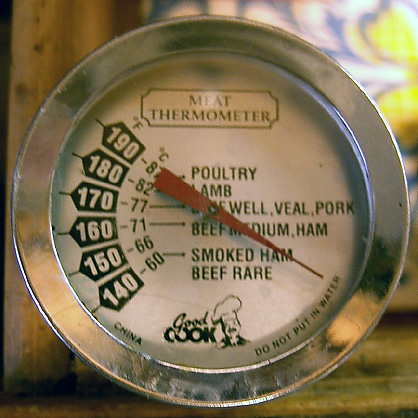 Critical for verifying poultry doneness (Image: Bev Sykes from Davis, CA, USA, CC BY 2.0, via Wikimedia Commons)
Cooking Methods and Techniques
1. Roasting
- Best for: Whole chickens, turkeys, or large game pieces (e.g., rabbit).
- Method: Dry heat in an oven (160–180°C). Baste with butter, herbs, or marinade for moisture.
- Example: Nepali "Koirako" (spiced roasted chicken) served at Thamel restaurants.
- Marinade: Yogurt + garlic + ginger + turmeric + chili.
- Roasting time: 1.5–2 hours (45 min/kg).
2. Braising
- Best for: Tough cuts (e.g., duck legs, rabbit shanks).
- Method: Sear first, then simmer in liquid (stock + wine/vegetables) at 90–100°C for 1–3 hours.
- Example: Duck à l’Orange (used in hotel buffets like Himalayan Java).
- Liquid: Duck stock + orange juice + honey.
- Time: 2 hours (duck legs).
3. Grilling
- Best for: Breast cuts, game birds (quail), or skewered pieces.
- Method: Direct high heat (200–250°C) for 3–5 minutes per side.
- Example: Grilled quail at Kathmandu’s "The Black Olive" (served with rosemary and lemon).
4. Frying
- Best for: Small pieces (e.g., chicken nuggets, duck confit).
- Methods:
- Pan-frying: 160–180°C oil, 5–8 minutes.
- Deep-frying: 170–190°C, 3–5 minutes (e.g., KFC-style fried chicken).
- Tip: Use peanut or vegetable oil (high smoke point).
In the Real World
Pathao’s "Chicken 65" Delivery
- Uses pre-marinated chicken breast (yogurt + spices) cooked via air-frying (180°C for 10 min) to ensure crispy exterior and juicy interior. The high-temperature short-time (HTST) method prevents dryness.
Nepalese Restaurants: "Sel Roti" (Duck Curry)
- Braising technique is key: Duck legs are seared, then slow-cooked in mustard oil, garlic, and spices for 2+ hours. Himalayan Java and Bhojan Griha use this for their signature dishes.
NTC’s Catering Services (Airport/Events)
- For large events, whole chickens are roasted in bulk (160°C for 2 hours) and carved into portions using sanitary gloves and separate boards. Leftovers are vacuum-sealed and stored at -18°C.
Comparative Analysis: Poultry vs. Game
| Feature | Poultry (Chicken/Duck) | Game (Rabbit/Quail) |
|---|---|---|
| Flavor | Mild to rich (duck) | Gamey, earthy (rabbit), delicate (quail) |
| Fat Content | Skin-on cuts are fatty (e.g., duck) | Leaner (rabbit), very tender (quail) |
| Cooking Time | Faster (30–90 min) | Slower (1–3 hours for rabbit) |
| Menu Pricing | Mid-range (₹400–₹1200) | Premium (₹1500–₹3000) |
| Hygiène Risk | High (Salmonella) | Moderate (unless wild-sourced) |
Worked Example: Costing a Menu Item
Dish: Herb-Roasted Quail with Lemon Butter Sauce Portion: 1 quail (2 birds = 1 kg) Ingredients and Costs (Nepal, 2024):
- Quail (live): ₹800/kg → ₹400 for 0.5 kg
- Butter: ₹200/250g → ₹50 for 60g
- Herbs (thyme, rosemary): ₹150/100g → ₹30
- Lemon: ₹40/unit → ₹20
- Stock: ₹100/L → ₹25 for 0.25L
- Total Cost: ₹505 Selling Price (3x cost): ₹1515 → ₹1600 (rounded)
Cooking Steps:
- Marinate: Quail in butter, herbs, lemon juice (4 hours).
- Roast: 180°C for 20–25 minutes (until skin crisps).
- Sauce: Reduce stock with lemon zest and herbs.
- Garnish: Fresh parsley.
Exam Tip
- Diagrams: Always label poultry cuts and cooking temperature curves (e.g., roasting vs. braising).
- Hygiene: Memorize the 6 critical steps (purchase → storage → thawing → prep → cooking → leftovers).
- Maths: Practice costing (e.g., "Calculate the selling price of a duck leg braised for 2 hours").
- Real-World Links: Connect techniques to Nepali dishes (e.g., koirako, sel roti) or global trends (e.g., air-frying in fast food).
- Short-Answer Tricks:
- For braising, say: "Low-temperature, moist-heat method for tough cuts."
- For game, say: "Requires longer cooking due to connective tissue."
Visual Summary:
flowchart TD
    A["Poultry/Game"] --> B["Hygiene: 6 Steps"]
    A --> C["Cooking Methods<br/>Roast/Braise/Grill/Fry"]
    A --> D["Cuts: Primals/Subprimals"]
    A --> E["Menu Apps:<br/>Quail in Hotels<br/>Duck in Restaurants"]
    B --> F["Cross-Contamination Prevention"]
    C --> G["Temperature Controls<br/>74°C Minimum"]
Based on the TU BHM syllabus for Food Production and Patisserie II (BHM302), unit 4.
Discussion
Loading…