Front Office Operations IIUnit 139 min read
Special Front Office Procedures & Terminologies
Unit 13 of Front Office Operations II: Explores niche but critical hotel operations like dead moves, mounting, foreign currency exchange, and special guest requests, with real-world applications in high-volume hotels and international chains.
TAKEAWAYS:
- Dead move and mounting are specialized room reassignments that require precise coordination to avoid guest dissatisfaction.
- Foreign currency exchange procedures must comply with Nepal Rastra Bank (NRB) regulations and hotel policies to prevent fraud.
- Special requests (e.g., dietary needs, accessibility) demand proactive communication to enhance guest experience.
- Emergency procedures (fire drills, medical evacuations) must be documented and practiced regularly.
- Terminologies like walk-in, no-show, and overstay directly impact revenue and staff workflow.
- Compliance with local laws (e.g., NRB for currency, tourism boards for special services) is mandatory.
1. Dead Move and Mounting: Room Reassignments
Definitions
- Dead Move: A room reassignment where a guest is moved from one room to another without their knowledge (e.g., due to maintenance, overbooking, or room upgrade).
- Mounting: A voluntary room upgrade or downgrade requested by the guest (e.g., for comfort, location preference).
How It Works
flowchart TD
    A["Guest Check-In"] --> B["Room Assignment"]
    B --> C["Check for Dead Move Conditions"]
    C -->|"Yes (Maintenance/Overbooking)"| D["Notify Front Desk"]
    D --> E["Assign New Room"]
    E --> F["Inform Guest (Dead Move) OR"]
    E -->|"Guest Requests"| G["Mounting (Upgrade/Downgrade)"]
    G --> H["Update PMS & Guest Folio"]
Key Differences
| Aspect | Dead Move | Mounting |
|---|---|---|
| Initiation | Front Office (unilateral) | Guest (bilateral) |
| Communication | Guest notified after reassignment | Guest requests upgrade/downgrade |
| Compensation | Often includes credit or apology | May involve extra charge or discount |
| PMS Update | Immediate room change | Requires guest confirmation |
Worked Example: Dead Move in a High-Rise Hotel
Scenario: Hotel Himalaya has a fire alarm in Room 305. The guest is blindfolded (for privacy) and moved to Room 307 while their luggage is transferred discreetly. Steps:
- Front desk identifies Room 305 as non-operational.
- Guest is briefly informed (e.g., "We’re moving you to a quieter room for comfort").
- Luggage is transferred via internal staff to avoid guest awareness.
- PMS updated with new room number and apology note in the folio.
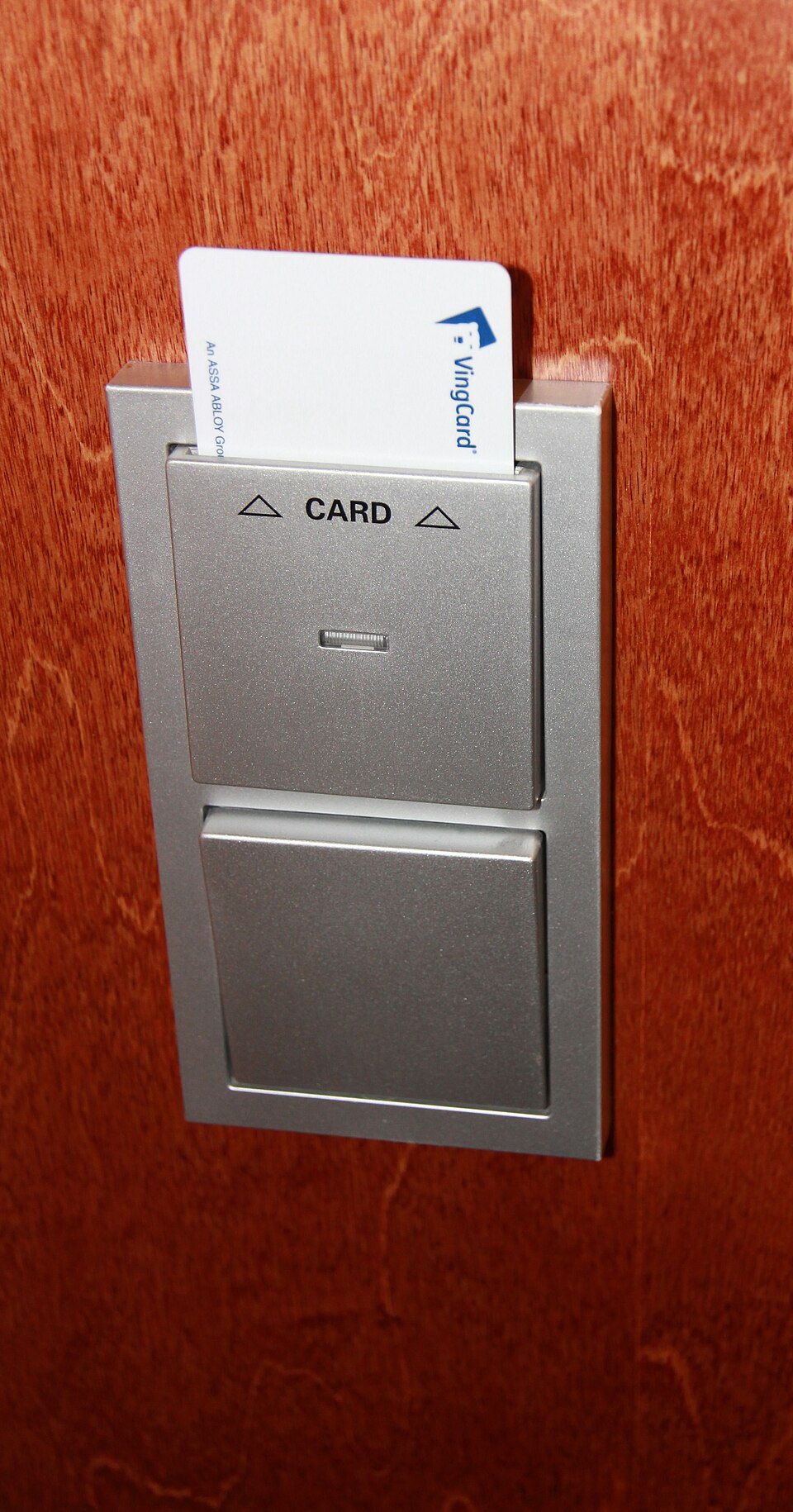 A standard key card used for room access, often linked to PMS for dead moves. (Image: MKFI, Public domain, via Wikimedia Commons)
2. Foreign Currency Exchange Procedures
Legal Framework in Nepal
- Nepal Rastra Bank (NRB) regulates exchange rates and limits.
- Hotels must register as authorized dealers for currency exchange.
- Maximum limit: NRs. 50,000 per transaction (varies by policy).
- Fees: Typically 1-2% of the exchange amount.
Step-by-Step Process
sequenceDiagram
    participant Guest
    participant FrontDesk
    participant ExchangeCounter
    participant Bank

    Guest->>FrontDesk: Requests exchange (e.g., USD to INR)
    FrontDesk->>ExchangeCounter: Verifies guest identity (passport/ID)
    ExchangeCounter->>Bank: Checks NRB rate & limits
    Bank-->>ExchangeCounter: Confirms rate (e.g., 1 USD = 120 INR)
    ExchangeCounter->>Guest: Provides receipt with rate & fees
    Guest->>ExchangeCounter: Submits currency
    ExchangeCounter->>Guest: Delivers Nepali rupees + receipt
Worked Example: Daraz Guest Exchange
Scenario: A guest from India orders via Daraz but pays in USD. They arrive at Hotel Everest and exchange USD 500. Steps:
- Guest shows passport and order confirmation.
- Front desk checks NRB’s interbank rate (e.g., 1 USD = 120.50 INR).
- Exchange counter deducts 1.5% fee (USD 7.50) → INR 59,262.50 delivered.
- Receipt issued with:
- Date, time, amount exchanged.
- NRB’s official rate.
- Hotel’s exchange rate (if different).
- Guest’s signature for compliance.
3. Special Guest Requests and Compliance
Common Requests and Handling
| Request Type | Example | Hotel Action |
|---|---|---|
| Dietary Needs | Vegan/halal meal | Coordinate with kitchen via PMS. |
| Accessibility | Wheelchair-accessible room | Assign room with ramp/elevator access. |
| Pets | Service animal permission | Verify pet policy (e.g., size, fees). |
| Quiet Hours | Noise complaint | Assign room away from lobby/pool. |
Compliance Checklist
- Nepal Tourism Board (NTB) guidelines for accessibility.
- Hotel’s service charge policy (e.g., pet fees).
- Guest agreement (e.g., signed waiver for pet stays).
Worked Example: Pathao Rider’s Special Request Scenario: A Pathao rider (guest) requests a non-smoking room and early check-in due to a shift. Steps:
- Front desk checks availability in non-smoking rooms.
- PMS flags early check-in (if allowed) and charges extra.
- Rider signs waiver for early check-in policy.
- Folio updated with "Pathao Rider – Early Check-In" note.
4. Emergency Procedures
Key Protocols
Fire Drills:
- Daily 10-minute drill (mandatory in Nepal).
- Escape routes posted in rooms (IMAGE: hotel fire escape route diagram | A labelled floor plan showing exits and assembly points).
- Staff training: 2 monthly fire safety workshops.
Medical Emergencies:
- First aid kit in every floor (IMAGE: hotel first aid kit labelled diagram | A stocked kit with bandages, antiseptics, and gloves).
- Emergency contact list (hospital, ambulance, nearest clinic).
- Guest medical form (for pre-existing conditions).
Natural Disasters (e.g., earthquake):
- Shelter areas marked (e.g., lobby, garden).
- Guest register updated with emergency contacts.
Worked Example: NTC Outage During Guest Stay
Scenario: A guest at Hotel Thamel loses power due to NTC outage. Steps:
- Front desk notifies maintenance to check power lines.
- Guest offered:
- Free Wi-Fi (backup generator).
- Complimentary room service (if outage >2 hours).
- Folio note: "NTC Outage – Compensation Offered."
5. Terminologies and Their Impact
| Terminology | Definition | Impact on Hotel |
|---|---|---|
| Walk-in | Guest arriving without reservation. | May lead to overbooking or upselling. |
| No-show | Guests who book but don’t arrive. | Revenue loss; must be tracked in PMS. |
| Overstay | Guest stays beyond checkout time. | Late fees or manual checkout process. |
| FIT (Free Independent Traveler) | Solo travelers without group discounts. | May require personalized service. |
In the Real World
eSewa’s Currency Exchange Feature:
- Idea: Dynamic exchange rates (like hotels).
- How: eSewa partners with NRB to offer real-time rates for users transferring money abroad. Hotels could integrate this for guests.
- Example: A guest using eSewa to convert USD to INR at the hotel’s exchange counter rate.
Daraz’s Special Request Handling:
- Idea: Guest customization (like dietary requests).
- How: Daraz allows note-to-seller for special delivery instructions (e.g., "Keep product chilled"). Hotels apply this to room service or special amenities.
- Example: A guest requests a gluten-free breakfast via Daraz order form; the hotel kitchen prepares it.
NTC’s Emergency Communication:
- Idea: Real-time updates (like fire drills).
- How: NTC’s SMS alerts during outages mirror how hotels notify guests of emergencies (e.g., "Evacuate to the garden").
- Example: During a power cut, NTC sends SMS; hotels could use PMS alerts to inform guests via email/SMS.
Exam Tip
- Terminology Questions: Define dead move and mounting with one real-world example (e.g., dead move for maintenance, mounting for upgrade).
- Procedures: For currency exchange, explain 3 steps (verification, rate check, receipt) and mention NRB compliance.
- Worked Examples: Always link to hotel scenarios (e.g., Pathao rider’s request, NTC outage) to show practical application.
- Compliance Focus: Highlight NTB/NRB rules—examiners test knowledge of legal requirements.
- PMS Integration: Mention how PMS tracks dead moves, no-shows, and special requests to streamline operations.
Sample Answer Structure:
"Dead move refers to a guest’s room reassignment without their prior knowledge, typically due to maintenance or overbooking. For example, at Hotel Everest, Room 203 was under repair, so the guest was moved to Room 205 without direct communication. The front desk ensured luggage was transferred discreetly, and the guest was informed upon arrival with an apology note in the folio. This process requires coordination between the front desk, housekeeping, and PMS to avoid guest dissatisfaction."
Based on the TU BHM syllabus for Front Office Operations II (BHM320), unit 13.
Discussion
Loading…