Facility Planning and ManagementUnit 1014 min read
Green Hotels: Design, Tech & Sustainability
Unit 10 of Facility Planning and Management explores sustainable hotel design principles, green technologies, waste management, and certification systems (e.g., LEED, Green Key) with real-world case studies like Himalayan Java and Nepal’s first eco-lodge, linking theory to exam expectations and industry practices.
TAKEAWAYS:
- Sustainable hotel design reduces environmental impact through energy efficiency, water conservation, and waste minimization, while enhancing guest experience and operational costs.
- Green technologies (solar panels, rainwater harvesting, LED lighting) and eco-friendly materials (bamboo, recycled wood) are core to modern hotel planning.
- Certifications (LEED, Green Key, EarthCheck) validate sustainability efforts and attract eco-conscious travelers.
- Waste management (composting, recycling, zero-waste kitchens) and circular economy principles (reusing, repairing) are critical for green operations.
- Case studies (e.g., The Himalayan Java, Nepal’s first carbon-neutral hotel) show how theory applies in practice.
- Exam focus: Expect comparisons (e.g., LEED vs. Green Key), calculations (e.g., energy savings), and short-answer definitions of key terms.
1. Defining Sustainable and Green Hotel Design
Sustainable hotel design integrates environmental responsibility, economic viability, and social equity into every aspect of hotel operations. Unlike traditional hotels, green hotels prioritize:
- Reduced carbon footprint (e.g., renewable energy, low-emission transport for guests).
- Resource efficiency (water, energy, materials).
- Waste reduction (zero-waste policies, recycling programs).
- Guest engagement (educating visitors on sustainability).
Why does this matter? Hotels consume 20–30% more energy and water per square meter than offices (UNEP). Sustainable design cuts costs (e.g., 30–50% energy savings via smart systems) and appeals to eco-tourists (a growing market: 34% of global travelers prioritize sustainability, Booking.com 2023).
2. Key Components of Green Hotel Design
A. Energy Efficiency
How it works: Green hotels use renewable energy sources (solar, wind, hydro) and energy-saving technologies (LED lighting, smart thermostats, motion sensors). For example:
- Passive solar design: Maximizing natural light to reduce artificial lighting needs.
- Energy-efficient HVAC: Heat recovery systems, zonal temperature control.
- On-site power generation: Solar panels (e.g., The Himalayan Java powers 60% of its energy via solar).
Worked Example: Solar Panel Calculation A 5-star hotel in Kathmandu installs 100 kW solar panels with 20% efficiency. If sunlight averages 5 hours/day at 1,000 W/m², calculate annual energy generation (assume 300 sunny days/year). Solution:
- Daily energy per panel: .
- Annual energy: . → Saves ~15 tons of CO₂/year (1 kWh ≈ 0.5 kg CO₂).
B. Water Conservation
Techniques:
- Rainwater harvesting: Stored for irrigation, toilet flushing (e.g., Nepal’s first eco-lodge, Annapurna Base Camp).
- Greywater recycling: Treating used water for non-potable uses (e.g., landscaping).
- Low-flow fixtures: Aerators, dual-flush toilets, sensor-activated taps.
- Drip irrigation: For hotel gardens (saves 50–70% water vs. traditional methods).
Worked Example: Rainwater Harvesting A hotel in Pokhara collects rainwater in a 50 m³ tank. If annual rainfall is 1,200 mm and the roof area is 200 m², calculate the potential annual collection (assuming 70% efficiency). Solution:
- Annual rainfall volume: . .
- Efficient collection: . → Covers 30% of the hotel’s water needs (assuming 500 m³/year usage).
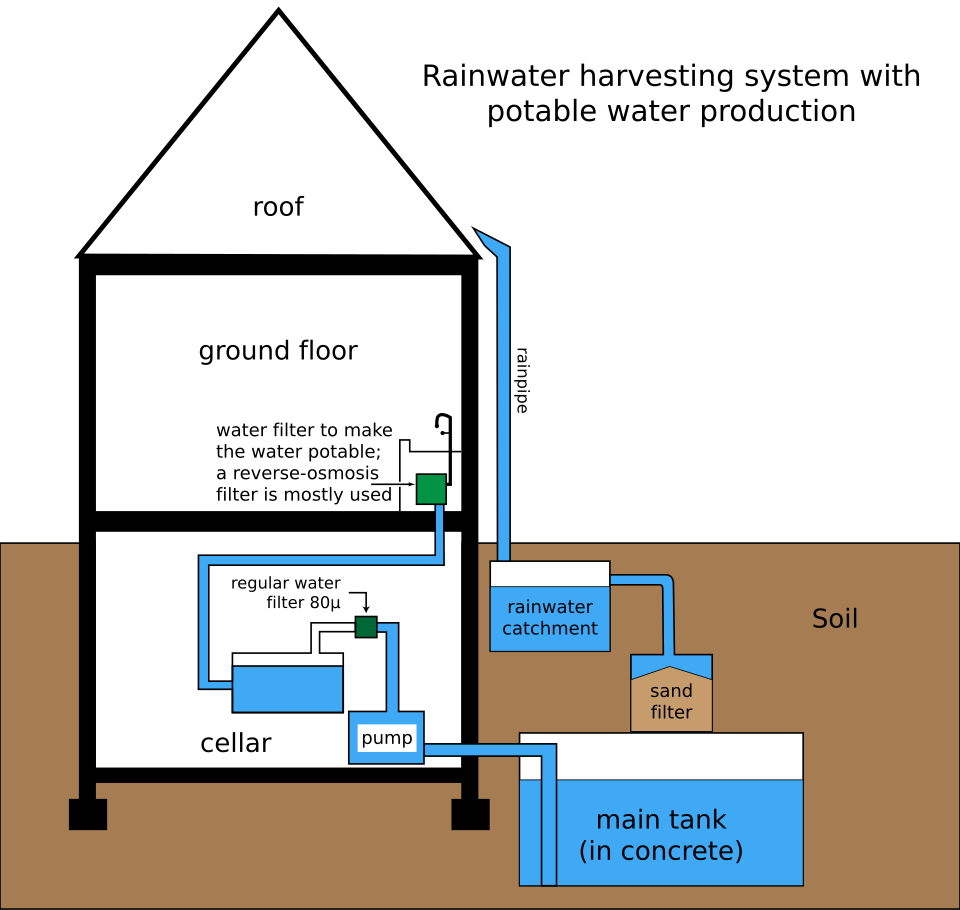 Components: roof, gutters, filter, storage tank, pump (Image: Rainwater_harvesting_system.JPG: KVDP (talk) derivative work, Public domain, via Wikimedia Commons)
C. Waste Management
Hierarchy: Reduce → Reuse → Recycle → Compost → Dispose (least preferred). Strategies:
- Zero-waste kitchens: Composting organic waste (e.g., 1612 Hotel, Bangkok diverts 90% of waste from landfills).
- Recycling programs: Separating glass, plastic, paper (e.g., Himalayan Java recycles 80% of waste).
- E-waste management: Safe disposal of electronics (partnerships with NGOs like Clean Up Nepal).
- Guest participation: Providing recycling bins in rooms and common areas.
Comparison Table: Waste Management Methods
| Method | Example | Pros | Cons |
|---|---|---|---|
| Composting | Kitchen scraps → fertilizer | Reduces landfill waste | Requires space and expertise |
| Recycling | Plastic bottles → new products | Lowers resource extraction | Needs guest compliance |
| Upcycling | Old furniture → new designs | Creates revenue streams | Labor-intensive |
| Landfill | Last resort for non-recyclables | Simple | High environmental cost |
3. Sustainable Materials and Construction
Eco-friendly materials reduce environmental harm and improve indoor air quality:
- Bamboo: Fast-growing, carbon-absorbing (used in The Himalayan Java’s furniture).
- Recycled wood: From reclaimed sources (e.g., Nepal’s first carbon-neutral hotel, Yeti Mountain Home).
- Low-VOC paints: Reduce indoor air pollution (critical for guest health).
- Reclaimed stone/brick: Used in pathways and exteriors.
Case Study: Yeti Mountain Home (Nepal)
- Materials: 90% locally sourced (stone, wood, clay).
- Energy: Solar panels + wood pellet stove.
- Water: Rainwater harvesting + greywater system.
- Result: Zero carbon footprint, certified by Green Key.
4. Green Technologies in Hotels
| Technology | Application | Example Hotel |
|---|---|---|
| Smart meters | Real-time energy/water tracking | The Oberoi, Udaipur (India) |
| LED lighting | 70% energy savings vs. incandescent | Himalayan Java |
| Geothermal heating | Uses underground heat for HVAC | Four Seasons, Bali |
| Biogas systems | Converts organic waste to energy | Eco Lodge, Chitwan |
| Automated HVAC | Zonal temperature control | Marriott Sustainable Hotels |
5. Sustainable Food and Beverage (F&B) Practices
Key Strategies:
- Local sourcing: Reduces carbon footprint (e.g., Himalayan Java sources 80% of ingredients from Nepal).
- Organic farming: Partnering with nearby organic farms (e.g., The Dwarika’s rooftop garden).
- Food waste reduction:
- Portion control (e.g., Nepal’s first zero-waste hotel, 1612 Kathmandu).
- Composting (e.g., The Himalayan Java turns 90% of food waste into compost).
- Doggy bags: Encouraging guests to take leftovers.
- Water-saving brewing: Coffee/tea made with rainwater or recycled greywater.
Worked Example: Carbon Footprint of a Meal Calculate the carbon footprint of a breakfast plate with:
- 2 eggs (100 g each, 4.5 kg CO₂/kg).
- 1 slice bread (50 g, 1.8 kg CO₂/kg).
- 1 cup coffee (200 ml, 0.3 kg CO₂/cup). Solution:
- Eggs: .
- Bread: .
- Coffee: . Total: . → A local, organic meal reduces this by 50–70% (sourced within 100 km).
6. Certification and Standards
Hotels achieve sustainability through third-party certifications:
| Certification | Issued by | Key Requirements | Example Hotel (Nepal) |
|---|---|---|---|
| LEED | US Green Building Council | Energy/water efficiency, materials, indoor air quality | The Himalayan Java (LEED Gold) |
| Green Key | Global Eco Tourism | Waste management, energy, water, guest education | Yeti Mountain Home |
| EarthCheck | EarthCheck | Environmental impact, guest satisfaction | Oberoi Hotels (Global) |
| Green Globe | Green Globe | Sustainability in operations, supply chain | Tara Resort, Pokhara |
How to Choose?
- LEED: Best for large-scale projects (high cost, rigorous standards).
- Green Key: Ideal for small/medium hotels (affordable, global recognition).
- EarthCheck: Focuses on guest experience + sustainability.
7. Case Study: The Himalayan Java, Kathmandu
Why it’s a model:
- Energy:
- 60% solar-powered.
- LED lighting + smart meters.
- Water:
- Rainwater harvesting (covers 30% needs).
- Greywater recycling for irrigation.
- Waste:
- Zero-waste kitchen (90% composted).
- Recycling program (80% diversion rate).
- Materials:
- Bamboo furniture, recycled wood.
- Certifications:
- LEED Gold, Green Key.
- Guest Engagement:
- Workshops on sustainability.
- Carbon offset options for stays.
8. Challenges and Solutions
| Challenge | Solution |
|---|---|
| High initial costs | Government grants (e.g., Nepal’s Green Hotel Incentive Scheme). |
| Guest resistance | Education (e.g., signage, workshops). |
| Maintenance of green tech | Partner with local eco-consultants. |
| Limited local suppliers | Collaborate with NGOs (e.g., Clean Up Nepal). |
9. The Future: Smart and Circular Hotels
Emerging Trends:
- AI-driven energy management: Predictive systems to optimize HVAC/lighting (e.g., Hilton’s Connected Room).
- Circular economy: Hotels as closed-loop systems (e.g., The Last Resort, Thailand uses 100% renewable energy + zero waste).
- Blockchain for transparency: Tracking supply chains (e.g., Windsor Court Hotel, UK uses blockchain for ethical sourcing).
In the Real World
Himalayan Java (Kathmandu)
- Idea: Rainwater harvesting + solar energy.
- How: Powers 60% of its electricity via solar and uses harvested rainwater for irrigation and flushing. Saves $5,000/year in utility bills while reducing CO₂ emissions by 20 tons/year.
Yeti Mountain Home (Nepal)
- Idea: Carbon-neutral operations.
- How: Uses biogas from food waste, geothermal heating, and locally sourced materials. Certified zero carbon footprint—a first in Nepal.
Daraz (Nepal’s Amazon)
- Idea: Sustainable logistics.
- How: Partners with electric delivery vans in Kathmandu to reduce emissions. Also promotes eco-friendly packaging (biodegradable materials for 30% of orders).
Nabil Bank’s Green Loans
- Idea: Financing sustainable hotels.
- How: Offers low-interest loans for hotels adopting solar panels or water-saving tech. 16 hotels in Nepal have availed this since 2022.
Pathao’s Electric Fleet
- Idea: Low-emission transport for guests.
- How: Expanding electric scooters for hotel transfers in Kathmandu/Pokhara. Reduces 1.2 tons of CO₂/month per 100 vehicles.
Exam Tip
What to Expect in TU/PU Exams
Short Answers (2–5 marks):
- Define: Green Key certification, passive solar design, greywater system.
- Example Q: "Explain how rainwater harvesting reduces a hotel’s water bill by 20%." → Use calculations + real-world data (e.g., Himalayan Java’s 30% coverage).
Long Answers (10–15 marks):
- Compare LEED and Green Key (use the table above + pros/cons).
- Design a sustainable F&B system for a 50-room hotel (include local sourcing, waste reduction, water-saving brewing).
- Case study analysis: "How does Yeti Mountain Home achieve zero carbon footprint?" → Cover energy, water, waste, materials.
Numerical Problems (5–10 marks):
- Energy savings: Calculate payback period for solar panels.
- Water conservation: Determine annual savings from low-flow fixtures.
- Carbon footprint: Compute emissions for a menu item (use the breakfast example above).
Diagrams (5 marks):
- Draw a flowchart of a hotel’s waste management system (use Mermaid below).
- Sketch a passive solar hotel design (label windows, insulation, shading).
True/False + Matching (2–5 marks):
- True/False: "Biogas reduces a hotel’s food waste by 100%." → False (only converts organic waste to energy; some waste remains).
- Match: Pair certifications with requirements (e.g., LEED → energy efficiency).
Mermaid Diagram: Hotel Waste Management Flowchart
Final Checklist for Full Marks
✅ Define key terms (e.g., circular economy, passive design). ✅ Compare certifications (LEED vs. Green Key) with a table. ✅ Calculate savings (energy, water, cost) with real data. ✅ Draw a flowchart or diagram (waste system, solar setup). ✅ Link to Nepal: Use Himalayan Java, Yeti Mountain Home, or Nabil Bank’s green loans. ✅ Critique challenges: Highlight solutions (e.g., government incentives).
Based on the TU BHM syllabus for Facility Planning and Management (BHM327), unit 10.
Discussion
Loading…