Fundamentals of TourismUnit 511 min read
Travel Motivation & Tourist Behaviour: Types, Factors & Consumer Decisions
Unit 5 of Fundamentals of Tourism explores why people travel (push/pull factors), the psychological and socio-cultural influences shaping tourist choices, and how these motivations translate into real-world travel decisions—from adventure tourism to cultural pilgrimages.
TAKEAWAYS:
- Push and pull factors explain travel motivation: internal desires ("push") and external attractions ("pull") drive decisions.
- Psychological theories (e.g., Maslow’s hierarchy) reveal how needs like self-actualization fuel tourism.
- Socio-cultural influences (family, peers, media) heavily shape travel preferences (e.g., solo vs. group trips).
- Tourist typologies (e.g., sun-seekers, cultural explorers) help businesses tailor marketing strategies.
- Decision-making models (e.g., the "tourist funnel") show how tourists evaluate options before booking.
- Nepal-specific examples (e.g., trekkers’ risk-taking vs. pilgrims’ spiritual needs) illustrate global-local applications.
1. Definitions: Travel Motivation and Tourist Behaviour
Travel motivation refers to the internal and external forces that inspire individuals or groups to travel. It is the why behind tourism—whether for relaxation, adventure, or cultural enrichment. Tourist behaviour, meanwhile, describes how tourists make decisions: researching destinations, choosing accommodations, and interacting with services.
Key distinction:
| Travel Motivation | Tourist Behaviour |
|---|---|
| Why people travel | How they plan, book, and experience travel |
| Driven by needs/wants | Influenced by budget, time, and preferences |
| Example: "I want to escape routine" | Example: "I’ll book a last-minute flight via eSewa" |
2. Theories of Travel Motivation
A. Push and Pull Factors
The push-pull model is the foundation of travel motivation theory. It divides influences into two categories:
Push Factors (Internal)
- Psychological needs: Escape, relaxation, self-discovery (e.g., a Kathmandu office worker booking a solo trek to Annapurna).
- Cultural needs: Heritage, tradition (e.g., Newari communities visiting Patan Durbar Square).
- Interpersonal needs: Family bonding, social status (e.g., a wedding trip to Pokhara).
- Status and prestige: Luxury travel (e.g., business class flights to Dubai).
flowchart TD
  A["Push Factors"] --> B["Psychological Needs"]
  A --> C["Cultural Needs"]
  A --> D["Interpersonal Needs"]
  A --> E["Status & Prestige"]
  B --> F["Escape routine"]
  C --> G["Heritage tourism"]
  D --> H["Family trips"]
  E --> I["Luxury travel"]
Pull Factors (External)
- Destination attributes: Climate, landscapes (e.g., Everest Base Camp for adventure seekers).
- Facilities: Hotels, transport (e.g., Pathao rides in Kathmandu).
- Events: Festivals, sports (e.g., Dashain/Maha Puja crowds in Nepal).
- Accessibility: Visa policies, flight routes (e.g., budget airlines like Buddha Air).
Real-world tie-in:
- eSewa’s role: Push factors (e.g., "I need a break") + pull factors (e.g., "eSewa offers easy flight bookings") combine to drive online travel bookings in Nepal.
B. Maslow’s Hierarchy Applied to Tourism
Abraham Maslow’s hierarchy of needs explains how tourism fulfills human desires at different levels:
| Level | Tourism Example | Nepal Case |
|---|---|---|
| Physiological | Food, shelter (e.g., homestays in Pokhara) | Guesthouses in rural areas |
| Safety | Secure travel (e.g., travel insurance) | NTC’s road safety campaigns |
| Social | Group tours, family trips | Thamel’s backpacker hostels |
| Esteem | Luxury resorts, VIP experiences | Hyatt Regency Kathmandu |
| Self-Actualization | Spiritual retreats, solo adventures | Meditation centers in Lumbini |
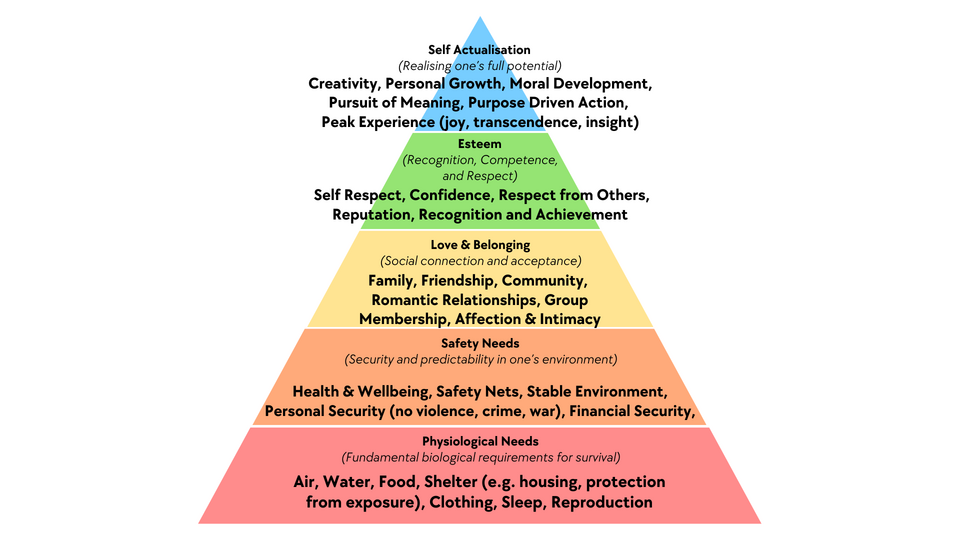 Shows how tourism addresses each level. (Image: Hamish.croker, CC BY-SA 4.0, via Wikimedia Commons)
3. Tourist Typologies: Who Are Your Customers?
Tourists aren’t monolithic. Classifying them helps businesses (hotels, tour operators) tailor services. Common typologies:
A. By Purpose of Visit
| Type | Description | Nepal Example |
|---|---|---|
| Leisure Tourists | Seek relaxation, recreation | Pokhara’s paragliding enthusiasts |
| Business Tourists | Attend conferences, trade shows | Kathmandu’s ITM Expo visitors |
| Cultural Tourists | Explore heritage, traditions | Lumbini pilgrims |
| Adventure Tourists | Thrill-seeking (trekking, rafting) | Annapurna Circuit trekkers |
| Medical Tourists | Seek healthcare (e.g., Ayurveda) | Patients at Patan Hospital |
B. By Travel Style
| Type | Behavior | Nepal Application |
|---|---|---|
| Organized Mass Tourists | Pre-booked packages, guided tours | CIAA’s group tours to Chitwan |
| Independent Tourists | DIY itineraries, flexible plans | Backpackers in Thamel |
| Explorers | Off-the-beaten-path, niche interests | Remote villages in Dolpo |
| Elite Tourists | High-end, exclusive experiences | Private jeep safaris in Bardia |
4. Decision-Making Process: The Tourist Funnel
Tourists don’t book impulsively. They follow a multi-stage decision-making model:
flowchart TD
  A["Need Recognition"] --> B["Information Search"]
  B --> C["Evaluation of Alternatives"]
  C --> D["Booking Decision"]
  D --> E["Post-Purchase Evaluation"]
  A -->|"Example"| F["I need a vacation"]
  B -->|"Example"| G["Google 'Pokhara hotels'"]
  C -->|"Example"| H["Compare prices on Daraz Travel"]
  D -->|"Example"| I["Book via Khalti"]
  E -->|"Example"| J["Leave review on TripAdvisor"]
Worked Example: Booking a Trek in Nepal
- Need: "I want to see mountains" (Push: adventure).
- Search: "Annapurna vs. Langtang trek" (Pull: destination attributes).
- Evaluation: Compare costs on Daraz Travel vs. local trekking agencies.
- Decision: Book via eSewa (convenience pull factor).
- Post-Trip: Share photos on Instagram (social pull for others).
5. Influences on Tourist Behaviour
A. Psychological Factors
- Perception: How tourists view destinations (e.g., "Nepal = trekking" vs. "Nepal = cultural hub").
- Attitudes: Prejudices (e.g., "Thamel is crowded") shape choices.
- Personality: Risk-takers vs. cautious travelers (e.g., solo trekkers vs. family groups).
B. Socio-Cultural Factors
- Family: Children influence destinations (e.g., Simara’s water parks).
- Peers: Social media trends (e.g., #NepalAdventure on Instagram).
- Culture: Religious tourism (e.g., Muktinath pilgrimage).
C. Economic Factors
- Income: Budget travelers (hostels) vs. luxury (5-star hotels).
- Exchange rates: Affordability of Nepalese Rupee (NPR) for foreign tourists.
- Seasonality: Peak (Oct–Nov) vs. off-season (monsoon) pricing.
6. Nepal-Specific Applications
A. Trekkers vs. Pilgrims: Contrasting Motivations
| Aspect | Trekkers (Adventure) | Pilgrims (Spiritual) |
|---|---|---|
| Push Factor | Thrill, challenge | Faith, penance |
| Pull Factor | Scenic trails, peaks | Sacred sites (Lumbini, Muktinath) |
| Decision Process | Research gear, permits | Follow religious itineraries |
| Behaviour | Book via agencies (e.g., Seven Summit) | Stay in monasteries, avoid meat |
B. Case Study: Kathmandu Traffic and Tourist Behaviour
- Problem: Tourists get frustrated with Kathmandu’s traffic (push: stress).
- Solution: Pathao (ride-hailing) and eSewa (online payments) reduce friction.
- Pull Factor: Ease of transport → more repeat visits.
In the Real World
eSewa and Khalti
- Idea Used: Pull Factor (Accessibility)
- How: These apps reduce booking friction by offering one-click payments for flights, hotels, and tours. A tourist’s push factor ("I need a break") meets the pull factor ("eSewa makes it easy") → higher conversions.
Daraz Travel
- Idea Used: Decision-Making Funnel
- How: Daraz aggregates flight/hotel options, letting users compare prices (Evaluation stage). Their "Express Checkout" via Khalti speeds up the Booking Decision.
NTC’s "Safe Travel" Campaigns
- Idea Used: Push Factor (Safety Needs)
- How: By advertising road safety (e.g., "Wear helmets"), NTC addresses the physiological/safety levels of Maslow’s hierarchy, encouraging more domestic tourism.
Pathao’s "Explore Nepal" Promotions
- Idea Used: Tourist Typologies (Independent Tourists)
- How: Targets solo travelers with discounts, tapping into the explorer segment who want flexibility.
Exam Tip
Define and Differentiate:
- Always distinguish between push (internal) and pull (external) factors. Examiners love precise definitions.
- Example: "Push factors are intrinsic desires like relaxation, while pull factors are destination-specific attractions like Pokhara’s paragliding."
Apply Theories to Nepal:
- Use Maslow’s hierarchy to explain why someone books a luxury resort (esteem) vs. a budget guesthouse (safety).
- Link tourist typologies to real businesses (e.g., "CIAA targets organized mass tourists").
Diagrams > Text:
- Draw the push-pull model or tourist funnel in exams. Label every box with Nepal examples (e.g., "Push: Escape routine → Pull: eSewa discounts").
Case Study Questions:
- If asked about traffic in Kathmandu, tie it to:
- Push: Stress from delays.
- Pull: Pathao’s convenience.
- Typology: Independent tourists frustrated by chaos.
- If asked about traffic in Kathmandu, tie it to:
Avoid Generic Answers:
- ❌ "Tourists travel for fun."
- ✅ "Adventure tourists like trekkers are driven by self-actualization (Maslow) and seek pull factors like scenic trails (e.g., Everest Base Camp)."
Visual Summary:
mindmap
  root((Travel Motivation & Behaviour))
    Push Factors
      Psychological
      Cultural
      Interpersonal
      Status
    Pull Factors
      Destination Attributes
      Facilities
      Events
      Accessibility
    Theories
      Maslow's Hierarchy
      Push-Pull Model
    Typologies
      Leisure
      Business
      Cultural
      Adventure
    Decision Process
      Need Recognition
      Information Search
      Evaluation
      Booking
      Post-Purchase
    Nepal Examples
      Trekkers vs. Pilgrims
      eSewa/Khalti
      Pathao Traffic Solutions
Based on the TU BHM syllabus for Fundamentals of Tourism (BHM331), unit 5.
Discussion
Loading…