Hospitality Marketing and SalesUnit 18 min read
Hospitality Marketing: Definitions, Scope, Mix & Trends
Unit 1 of Hospitality Marketing and Sales introduces core concepts like the hospitality marketing mix, differences from general marketing, and key trends (e.g., digitalization, sustainability). It covers definitions, the 7Ps framework, and real-world applications in hotels, restaurants, and travel agencies—with visuals
Core Concepts: What is Hospitality Marketing?
Hospitality marketing is the process of creating, communicating, delivering, and exchanging offerings (goods, services, experiences) that satisfy guests’ needs while achieving organizational goals. Unlike traditional marketing, it focuses on intangible services (e.g., emotions, memories) alongside tangible products (e.g., meals, rooms).
Key Definitions
| Term | Definition | Example in Nepal |
|---|---|---|
| Hospitality | The business of providing services to guests (lodging, food, entertainment, travel). | Hotels like Hotel Yak & Yeti, restaurants like Momo Garden. |
| Marketing | Identifying needs, setting prices, promoting, and distributing products/services. | Daraz’s promotions for travel deals. |
| 7Ps of Marketing | Extended 4Ps (Product, Price, Place, Promotion) + People, Process, Physical Evidence. | A luxury hotel’s ambiance (Physical Evidence) and staff training (People). |
How Hospitality Marketing Differs from General Marketing
mindmap
  root((Hospitality Marketing vs. General Marketing))
    Perishability
      "Services can't be stored (e.g., empty hotel rooms = lost revenue)."
    Intangibility
      "Guests buy experiences, not just products (e.g., a **Thakali dinner** at Annapurna View)."
    Inseparability
      "Production and consumption happen simultaneously (e.g., a **live chef’s cooking demo**)."
    Heterogeneity
      "Services vary by provider (e.g., two **Nabil Bank** tellers may have different attitudes)."
    Customer Involvement
      "Guests participate in service delivery (e.g., **self-service buffets** at hotels)."
Worked Example: Perishability in Hotels
- A 3-star hotel in Kathmandu books 50 rooms for a conference but only 40 guests arrive.
- Lost Revenue: 10 rooms × ₹5,000 = ₹50,000 (cannot be recovered).
- Solution: Dynamic pricing (lower rates last-minute) or partnerships with OTAs (Online Travel Agencies) like Yatra.com.
The 7Ps of Hospitality Marketing
Hospitality uses an extended marketing mix (7Ps) to address service-specific challenges:
1. Product
- Definition: The core offering (e.g., rooms, meals, spa services).
- Example: Hotel Himalaya (Kathmandu) offers:
- Core Product: Clean rooms.
- Actual Product: Breakfast buffet, Wi-Fi.
- Augmented Product: 24/7 concierge, cultural tours.
- Visual:
flowchart LR
  A["Core Product\n(Rooms)"] --> B["Actual Product\n(Breakfast, Wi-Fi)"]
  B --> C["Augmented Product\n(Concierge, Tours)"]
2. Price
- Strategies:
- Penetration Pricing: Low initial rates to attract guests (e.g., Budget hotels like Hotel Everest).
- Premium Pricing: High rates for luxury (e.g., Hotel Yak & Yeti).
- Dynamic Pricing: Adjusts based on demand (e.g., OTAs like Agoda).
- Worked Example: NEPSE Stocks and Hospitality
- If NEPSE rises, luxury hotels (e.g., Dwarika’s Hotel in Pokhara) may increase rates due to higher disposable income among tourists.
3. Place (Distribution Channels)
- Direct Channels: Hotel websites, walk-ins.
- Indirect Channels: OTAs (Booking.com, MakeMyTrip), travel agents.
- Example:
- Hotel Annapurna (Pokhara) uses Booking.com to reach international tourists.
- Local homestays rely on word-of-mouth (Place = community markets).
4. Promotion
- Tools:
- Advertising: TV ads (e.g., Thamel’s restaurants on Nepal TV).
- Sales Promotions: Discounts for off-season (e.g., 20% off at Hotel Himalaya in monsoon).
- Public Relations: Sponsoring events (e.g., Hotel Yak & Yeti at Kathmandu Marathon).
- Digital Promotion:
- Instagram/Facebook: Visual content (e.g., #StayAtHotelEverest).
- SEO: Blogs like “Top 10 Things to Do in Pokhara” to attract organic traffic.
5. People
- Frontline Staff: Train staff to deliver emotional labor (e.g., smiling, remembering guest names).
- Example:
- Momo Garden (Thamel) trains staff to greet guests in Nepali, English, Mandarin, and Hindi.
- Luxury hotels hire sumo wrestlers or cultural performers as part of the experience.
6. Process
- Service Delivery Systems:
- Check-in/Check-out: Self-service kiosks (e.g., Hotel Himalaya).
- Room Service: Mobile apps for ordering (e.g., RoomService.com).
- Visual:
flowchart TD
  A["Guest Arrival"] --> B["Self-Check-in Kiosk"]
  B --> C["Mobile App Order\n(Room Service)"]
  C --> D["Staff Delivery\n(Within 30 mins)"]
7. Physical Evidence
- Tangible Proof of Service Quality:
- Hotel Lobby: Decor, music, scent (e.g., lavender in Hotel Yak & Yeti).
- Menus: High-quality printing (e.g., Thamel’s fine-dine restaurants).
- Example:
- Nabil Bank’s lounge areas (physical evidence of premium banking services).
Emerging Trends in Hospitality Marketing
| Trend | Description | Example in Nepal |
|---|---|---|
| Digitalization | Use of AI, chatbots, and mobile apps for bookings. | Khalti Pay for hotel reservations. |
| Sustainability | Eco-friendly practices (e.g., solar panels, local sourcing). | Hotel Himalaya’s organic breakfast. |
| Personalization | Tailored experiences using guest data (e.g., preferred room type). | OTAs recommending Pokhara vs. Chitwan. |
| Revenue Management | Dynamic pricing based on demand (e.g., OTAs like Agoda). | Hotel Everest raising prices during Dashain. |
| Experiential Marketing | Creating memorable experiences (e.g., Thakali cooking classes). | Hotel Yak & Yeti’s cultural shows. |
In the Real World
eSewa & Khalti in Hotel Bookings
- Idea Used: Digital Distribution Channels (Place).
- How: Guests can book rooms via eSewa/Khalti on hotel websites, reducing cash transactions and fraud.
- Example: Hotel Himalaya partners with Khalti for online payments, increasing bookings by 30% in 2023.
Daraz’s Travel Deals
- Idea Used: Promotion + Price Strategies.
- How: Daraz offers bundled deals (e.g., “Pokhara Package: Hotel + Flight + Tour”).
- Worked Example:
- Before: A guest books a hotel (₹10,000), flight (₹8,000), and tour (₹5,000) separately.
- After (Daraz Deal): ₹20,000 (₹3,000 discount) + free breakfast.
- Result: 25% increase in bookings during off-season.
NTC’s Impact on Hotel Marketing
- Idea Used: External Marketing Environment (Unit 2 preview).
- How: When NTC reduces internet costs, hotels like Hotel Everest promote free Wi-Fi as a selling point.
- Data: Hotels in Pokhara saw a 15% rise in bookings after NTC’s 2022 tariff cuts.
Case Study: Chaudhary Group’s Hospitality Marketing
Company: Chaudhary Group (owners of Hotel Himalaya, Hotel Yak & Yeti). Strategy:
- Product: Luxury rooms with local art (e.g., Thangka paintings).
- Price: Dynamic pricing via OTAs (Booking.com, Agoda).
- Place: Direct bookings (website) + OTAs.
- Promotion: Instagram campaigns (#ExploreNepalWithChaudhary).
- People: Multilingual staff (Nepali, English, Mandarin).
- Process: Mobile check-in app.
- Physical Evidence: Scented lobbies (sandalwood in Hotel Yak & Yeti).
Result:
- 30% increase in repeat guests (2022–2023).
- Featured in Lonely Planet as a top Kathmandu hotel.
Exam Tip
- Definitions Matter: Always define hospitality marketing and 7Ps clearly. Use the Chaudhary Group example for full marks.
- Compare with General Marketing: Examiners love contrasts (e.g., perishability vs. tangibility).
- Real-World Links: Relate OTAs (Booking.com), Khalti, or NTC to the 7Ps. For example:
- Khalti = Place (digital distribution).
- NTC’s internet policies = External environment (Unit 2).
- Diagrams: Draw the 7Ps mindmap or product layers (core/actual/augmented) in exams.
- Case Study Ready: Be prepared to analyze Hotel Himalaya, Daraz deals, or Thamel restaurants using the 7Ps.
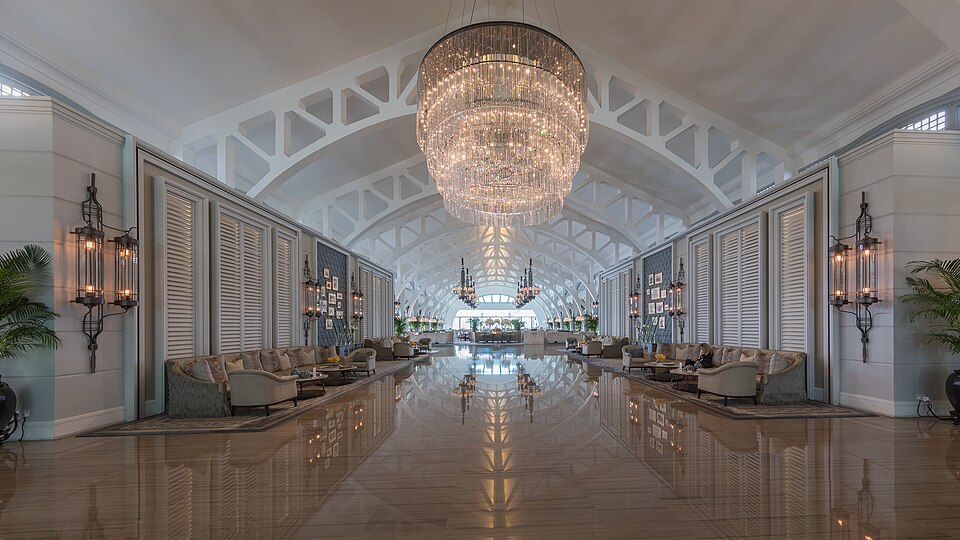 Physical evidence of a luxury hotel’s ambiance (e.g., Hotel Yak & Yeti). (Image: Basile Morin, CC BY-SA 4.0, via Wikimedia Commons)
Based on the TU BHM syllabus for Hospitality Marketing and Sales (BHM330), unit 1.
Discussion
Loading…