StatisticsUnit 88 min read
Probability: Basic Concepts, Addition and Multiplication Theorems, and Bayes' Theorem
Unit 8 of Statistics: This note covers the fundamental concepts of probability, including sample spaces, types of probability, addition and multiplication rules, conditional probability, and the application of Bayes' Theorem in decision-making.
Key points
- Probability measures the likelihood of an event occurring, ranging from 0 (impossible) to 1 (certain).
- The Addition Theorem handles "OR" scenarios, adjusting for overlapping events.
- The Multiplication Theorem handles "AND" scenarios, distinguishing between independent and dependent events.
- Conditional probability calculates the likelihood of an event given that another event has already occurred.
- Bayes' Theorem allows for the revision of prior probabilities based on new evidence.
Introduction to Probability
Probability is the branch of mathematics that deals with the numerical description of how likely an event is to occur. In the hospitality industry, probability is used for forecasting room occupancy, managing food waste, and assessing the risk of flight delays for arriving guests.
Basic Terminology
Before calculating probabilities, we must understand the building blocks:
- Random Experiment: An action or process that leads to one of several possible outcomes, where the exact outcome cannot be predicted with certainty.
- Example: Tossing a coin or checking if a guest will check out on time.
- Sample Space (): The set of all possible outcomes of a random experiment.
- Example: For a single die roll, .
- Event (): A subset of the sample space. It is a specific outcome or a collection of outcomes we are interested in.
- Example: Rolling an even number, .
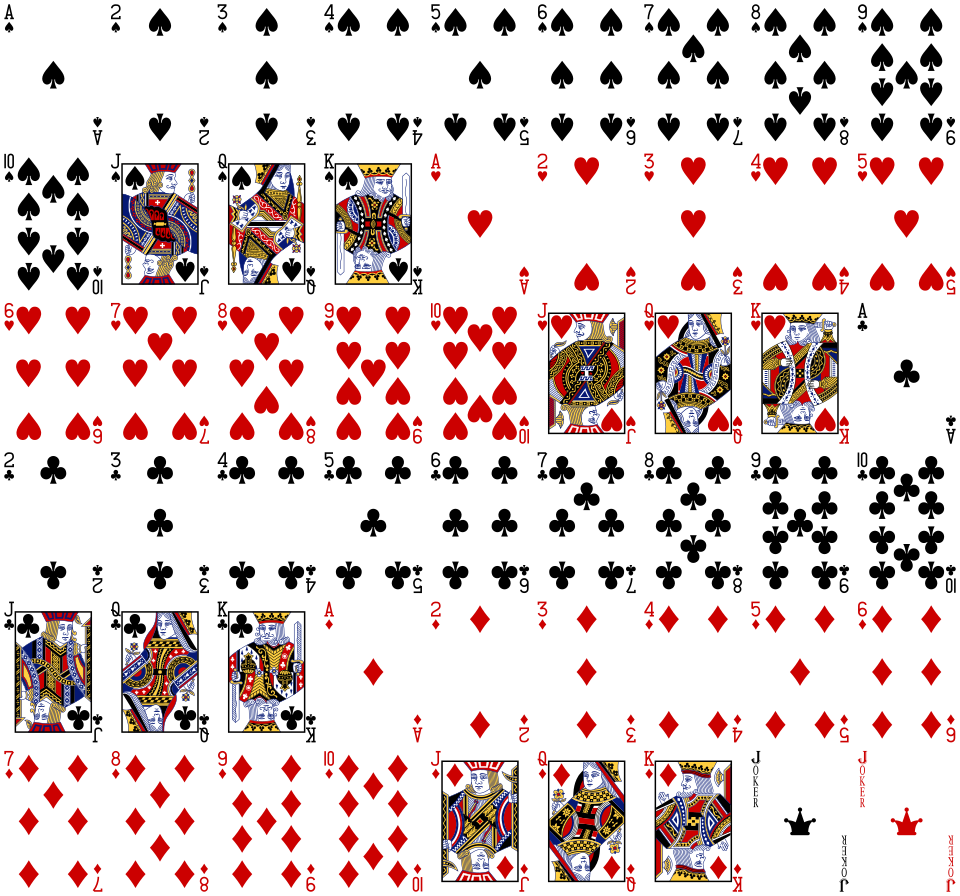 A standard 52-card deck used to demonstrate sample spaces and events. (Image: AustinGabriel64, CC0, via Wikimedia Commons)
Approaches to Probability
There are three primary ways to assign probability to an event:
| Approach | Definition | Formula | Use Case |
|---|---|---|---|
| Classical | Based on theoretical symmetry where all outcomes are equally likely. | Tossing coins, rolling dice. | |
| Empirical | Based on historical data or observed frequencies. | Predicting guest arrivals based on last year's data. | |
| Subjective | Based on personal judgment, experience, or intuition. | No fixed formula | An expert predicting a hotel's success in a new city. |
Worked Example 1: Classical Probability
Question: A hotel manager has a bowl containing 5 red, 3 blue, and 2 green key cards. If one card is picked at random, what is the probability that it is either blue or green?
Step-by-step Solution:
- Identify the Sample Space (): Total cards = . So, .
- Identify the Event (): The event is picking a blue or green card.
- Number of blue cards = 3
- Number of green cards = 2
- Total favorable outcomes .
- Apply the Formula:
Types of Events
Understanding the relationship between events is crucial for choosing the right theorem.
Addition Theorem of Probability
The Addition Theorem is used when we want to find the probability of event OR event occurring ().
1. Mutually Exclusive Events
Events are mutually exclusive if they cannot occur at the same time. Formula:
2. Non-Mutually Exclusive Events
Events are non-mutually exclusive if they can occur simultaneously. To avoid double-counting the overlap, we subtract the intersection. Formula:
Worked Example 2: Non-Mutually Exclusive Events
Question: In a hotel staff of 100 employees, 60 speak English, 40 speak Nepali, and 20 speak both. If an employee is chosen at random, what is the probability they speak English or Nepali?
Step-by-step Solution:
- Define Events:
- : Probability of speaking English =
- : Probability of speaking Nepali =
- : Probability of speaking both =
- Apply Addition Theorem:
- Result: The probability is 0.8 or 80%.
Conditional Probability and Multiplication Theorem
Conditional Probability
Conditional probability is the probability of an event occurring, given that event has already occurred. It is denoted by .
Formula:
Multiplication Theorem
This theorem is used to find the probability of event AND event occurring ().
- For Independent Events: The outcome of one does not affect the other.
- For Dependent Events: The outcome of the first affects the second.
Worked Example 3: Dependent Events
Question: A restaurant has 10 dinner plates, 3 of which are chipped. If a waiter picks 2 plates one after another without replacement, what is the probability that both are chipped?
Step-by-step Solution:
- First Event (): Picking the first chipped plate.
- Second Event (): Picking the second chipped plate given the first was chipped.
- Remaining chipped plates = 2
- Remaining total plates = 9
- Apply Multiplication Theorem:
Bayes' Theorem
Bayes' Theorem is a powerful tool used to update the probability of a hypothesis as more evidence or information becomes available. It is essentially the "reverse" of conditional probability.
Formula: Where (the total probability) is often calculated as:
Worked Example 4: Bayes' Theorem in Hotel Management
Question: A hotel receives bookings from three sources: Online (60%), Travel Agent (30%), and Direct (10%). The probability of a "No-Show" (guest doesn't arrive) is 5% for Online, 2% for Agents, and 1% for Direct bookings. If a guest is a "No-Show", what is the probability they booked Online?
Step-by-step Solution:
- Prior Probabilities:
- Conditional Probabilities (Likelihood of No-Show):
- Total Probability of No-Show :
- Apply Bayes' Theorem: Result: There is an 81.08% probability that the no-show guest booked online.
In the real world
Probability is not just a classroom exercise; it is the engine behind many services in Nepal:
- Insurance Companies (e.g., Nepal Insurance Company): They use Empirical Probability and actuarial tables to determine premiums. If historical data shows a 2% probability of a hotel fire in a certain area, the premium is calculated based on that risk.
- Ride-Sharing Apps (Pathao/InDrive): These apps use Conditional Probability to estimate "Time of Arrival" (ETA). The probability of a driver arriving in 5 minutes is conditional upon the current traffic density in Kathmandu (e.g., ).
- E-commerce (Daraz): Daraz uses probability for its recommendation engine. If you bought a hotel towel, the probability that you might need a bath mat is higher. This is a form of Joint Probability used in "Frequently Bought Together" sections.
Exam tip
When solving probability questions in the TU board exam, follow these steps to ensure full marks:
- Define your events clearly: Always start by writing "Let and ".
- State the formula: Write the general formula (e.g., the Addition Theorem) before plugging in the numbers.
- Check for Mutual Exclusivity: Before using , explicitly state whether the events are mutually exclusive or not.
- Simplify Fractions: Always provide the final answer in both fraction and decimal/percentage form.
- Bayes' Theorem Layout: For Bayes' problems, create a small table for Prior and Conditional probabilities first; this prevents calculation errors in the total probability denominator.
Based on the TU BHM syllabus for Statistics (STT311), unit 8.
Discussion
Loading…