Food and Beverage Service Operation IIIUnit 510 min read
Wine Regions, Terroir & Global Vineyards
Unit 5 of Food and Beverage Service Operation III explores the world’s premier wine regions—France, Italy, Spain, USA, Australia, Chile, and South Africa—highlighting their unique climates, grape varieties, and cultural influences on wine production. Learn how terroir shapes flavor, and master the art of pairing wines
Key Wine Regions & Their Signature Styles
1. France: The Birthplace of Wine Classification
France is the epicenter of wine culture, home to 56 wine regions and the Appellation d’Origine Contrôlée (AOC) system, which regulates grape varieties, yields, and production methods. Its wines are categorized by region, grape, and quality level (e.g., Vin de Table → Vin de Pays → AOC → Grand Cru).
Major French Wine Regions & Their Stars
mindmap
  root((France))
    Bordeaux
      "Red Blends: Cabernet Sauvignon, Merlot, Cabernet Franc"
      "Left Bank (Medoc): Cabernet-dominant (e.g., Château Margaux)"
      "Right Bank (Saint-Émilion): Merlot-dominant (e.g., Château Cheval Blanc)"
      "Sweet Wines: Sauternes (Botrytis-affected Sémillon)"
    Burgundy
      "Pinot Noir (red) & Chardonnay (white)"
      "Grand Cru vineyards (e.g., Domaine de la Romanée-Conti)"
      "Terroir-driven: Soil (limestone, clay) > grape variety"
    Champagne
      "Sparkling wine from Méthode Champenoise"
      "Grapes: Pinot Noir, Pinot Meunier, Chardonnay"
      "Regulated by Comité Champagne (strict rules)"
    Loire Valley
      "Chenin Blanc (dry/sweet, e.g., Vouvray)"
      "Cabernet Franc (red, e.g., Chinon)"
    Rhône Valley
      "Northern Rhône: Syrah (e.g., Hermitage)"
      "Southern Rhône: GSM blends (Grenache, Syrah, Mourvèdre)"
    Alsace
      "Riesling, Gewürztraminer, Pinot Gris (aromatic whites)"
Worked Example: Bordeaux Blends
- Left Bank (e.g., Château Lafite Rothschild):
- Grape Mix: 70% Cabernet Sauvignon (structure), 20% Merlot (softness), 10% Cabernet Franc (aroma).
- Flavor Profile: Blackcurrant, cedar, tobacco.
- Pairing: Grilled lamb, aged cheddar, dark chocolate.
- Right Bank (e.g., Château Pétrus):
- Grape Mix: 80% Merlot, 15% Cabernet Franc, 5% Cabernet Sauvignon.
- Flavor Profile: Plum, violet, chocolate.
- Pairing: Duck confit, blue cheese, mushroom risotto.
2. Italy: Diversity in Grape Varieties
Italy has 20 regions, each with indigenous grapes (e.g., Sangiovese, Nebbiolo, Prosecco). The Denominazione di Origine Controllata (DOC/DOCG) system ensures quality.
Key Italian Regions
| Region | Signature Grape(s) | Famous Wines | Terroir Features |
|---|---|---|---|
| Tuscany | Sangiovese | Chianti, Brunello di Montalcino | Rolling hills, Mediterranean climate |
| Piedmont | Nebbiolo | Barolo, Barbaresco | Cool nights, warm days, limestone |
| Veneto | Corvina, Rondinella | Valpolicella, Amarone | Volcanic soil, high altitude |
| Sicily | Nero d’Avola, Grillo | Marsala, Etna Rosso | Hot, dry climate, mineral-rich soil |
| Trentino | Pinot Noir, Chardonnay | Trento DOC | Alpine influence, cool climate |
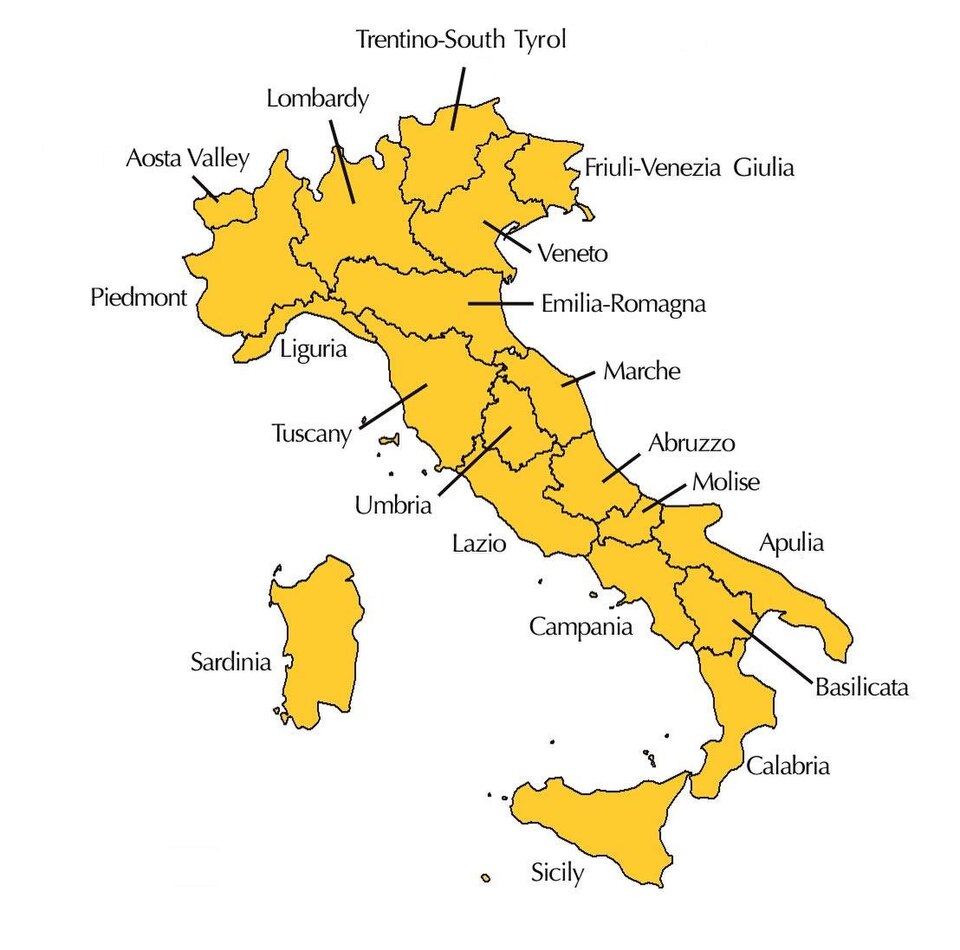 Highlighting Tuscany, Piedmont, Veneto. (Image: CC BY-SA 3.0, via Wikimedia Commons)
Worked Example: Barolo vs. Chianti
- Barolo (Piedmont):
- Grape: 100% Nebbiolo.
- Aging: Minimum 38 months (18 in wood).
- Flavor: Tar, rose, truffle, leather.
- Pairing: Truffle pasta, braised beef, aged Parmigiano.
- Chianti (Tuscany):
- Grape: 70–100% Sangiovese + Canaiolo, Colorino.
- Aging: Minimum 12 months (some in wood).
- Flavor: Cherry, dried herbs, earth.
- Pairing: Tomato-based dishes (e.g., ribollita soup), pecorino cheese.
3. Spain: Sherry, Rioja, and Tempranillo
Spain is famous for fortified wines (Sherry) and Tempranillo-based reds. The Denominación de Origen (DO) system classifies wines by region.
Key Spanish Regions
mindmap
  root((Spain))
    Andalusia
      "Sherry (Fino, Amontillado, Oloroso)"
      "Solera aging system (blending old/new wine)"
    Rioja
      "Tempranillo (red), Viura (white)"
      "Aging categories: Crianza, Reserva, Gran Reserva"
    Ribera del Duero
      "Tempranillo (bold, high-alcohol)"
    Priorat
      "Garnacha (Grenache), Cariñena"
      "Slate-rich soil (mineral intensity)"
Worked Example: Sherry Solera System
- Fino Sherry:
- Aging: Biological aging (flor yeast) in 600L American oak barrels.
- Flavor: Almond, green apple, brine.
- Serving: Chilled (6–8°C) with tapas (olives, anchovies, manchego cheese).
- Oloroso Sherry:
- Aging: Oxidative aging (no flor), darker, richer.
- Flavor: Dried fruit, caramel, nuts.
- Pairing: Dark chocolate, cured meats.
4. New World Wine Regions: USA, Australia, Chile, South Africa
These regions adopted European grapes but developed unique styles due to climate and innovation.
Comparison Table: New World vs. Old World
| Feature | Old World (France/Italy) | New World (USA/Australia) |
|---|---|---|
| Grape Focus | Indigenous varieties | International varieties (Cabernet, Chardonnay) |
| Winemaking | Traditional, terroir-driven | Experimental (oak, clones, tech) |
| Labels | Region + grape (e.g., "Bordeaux") | Vineyard + winemaker (e.g., "Robert Parker’s Cabernet") |
| Price | Often higher (heritage) | Often more affordable |
Key New World Regions
| Region | Signature Grape(s) | Famous Wines | Terroir Features |
|---|---|---|---|
| Napa Valley | Cabernet Sauvignon | Opus One, Caymus | Mediterranean climate, volcanic soil |
| Sonoma | Pinot Noir, Zinfandel | Dry Creek Valley, Russian River | Foggy mornings, warm days |
| Barossa | Shiraz (Syrah) | Penfolds Grange | Hot, dry, ancient vineyards |
| Central Otago | Pinot Noir | Felton Road | Cool climate, high altitude |
| Maipo Valley | Carmenère, Cabernet | Almaviva, Concha y Toro | Irrigation from Andes |
| Stellenbosch | Chenin Blanc, Pinotage | Delaire Graff, Kloof Street | Cool coastal breezes |
Worked Example: Napa Valley Cabernet Sauvignon
- Grape: 85% Cabernet Sauvignon, 15% Merlot/Cabernet Franc.
- Winemaking:
- Oak Aging: 18–24 months in French oak (vanilla, spice).
- Clones: Optima (high yield), Cabernet Franc crosses (aroma).
- Flavor: Blackberry, cedar, mocha.
- Pairing: Nepali Context: Pair with yak cheese platter or spiced lamb roast (common in Kathmandu restaurants like Bhojan Griha).
Terroir: The Soul of Wine
Terroir (French: "soil + climate") defines a wine’s unique character. Key factors:
- Climate: Temperature, rainfall, sunlight (e.g., cool Burgundy vs. hot Barossa).
- Soil: Mineral content (e.g., limestone in Champagne, schist in Priorat).
- Elevation: Higher altitude = slower ripening (e.g., Mendoza, Argentina).
- Aspect: North-facing slopes (cooler) vs. south-facing (warmer).
In the Real World
eSewa & Khalti (Nepal):
- How it uses wine knowledge: High-end restaurants in Thamel (e.g., Kaiser Café, Bhojan Griha) source imported wines (e.g., Bordeaux, Barolo) for special menus. Staff must explain region, grape, and pairing to customers paying Rs. 2,000–5,000 per bottle.
- Example: A Nepali guest ordering a steak might be suggested a Malbec from Argentina (bold, fruity) or a Pinot Noir from Central Otago (earthy, elegant).
Daraz & Pathao (Nepal):
- Wine Delivery: Platforms like Daraz Wine Shop and Pathao’s premium food delivery now offer curated wine boxes (e.g., New Zealand Sauvignon Blanc, Chilean Carmenère). Delivery agents must handle bottles properly (never store upright, avoid temperature shocks).
Nepal Tourism (Kathmandu/Pokhara):
- Wine Bars: The Black Olive (KTM) and Purple Haze (Lakeside) import small-batch wines from France, Italy, and New Zealand. Sommeliers use wine region knowledge to create tasting flights (e.g., "Journey Through Bordeaux").
- Hotel Buffets: Himalayan Java (KTM) pairs Chardonnay from Burgundy with seafood dishes (e.g., grilled mahseer) to attract international tourists.
Exam Tip: How to Score Full Marks
Maps & Regions:
- Memorize: Top 5 Old World (France, Italy, Spain, Portugal, Germany) and Top 3 New World (USA, Australia, Chile) regions.
- Exam Trick: Draw a simple mindmap in the exam linking region → grape → flavor → food pairing.
Grape Varieties:
- Must Know:
- Red: Cabernet Sauvignon, Merlot, Sangiovese, Nebbiolo, Tempranillo, Shiraz, Pinotage.
- White: Chardonnay, Sauvignon Blanc, Riesling, Chenin Blanc, Pinot Grigio.
- Example Question: "Which grape is used in Chianti and why?" Answer: Sangiovese (high acidity, medium tannins) → pairs with tomato-based dishes (common in Italian cuisine).
- Must Know:
Pairing Questions:
- Formula:
- Red Wine + Red Meat (e.g., Barolo + beef).
- White Wine + Seafood/Poultry (e.g., Sauvignon Blanc + grilled salmon).
- Sparkling Wine + Spicy Food (e.g., Prosecco + Nepali momos).
- Nepali Context:
- Thukpa (Nepali noodle soup) → Riesling (off-dry) or Pinot Noir (light).
- Yak cheese → Malbec (bold tannins).
- Formula:
Terroir vs. Technology:
- Old World: Focus on terroir (e.g., "Burgundy’s limestone gives Chardonnay its minerality").
- New World: Focus on winemaker innovation (e.g., "Napa Valley uses micro-climates and clones for Cabernet Sauvignon").
Common Pitfalls:
- ❌ Saying "All French wines are red" (Champagne, Bordeaux whites, Alsace Riesling exist).
- ❌ Confusing Barolo (Nebbiolo) with Chianti (Sangiovese).
- ❌ Ignoring fortified wines (Sherry, Port) in Spanish/Portuguese regions.
Final Visual Summary:
Based on the TU BHM syllabus for Food and Beverage Service Operation III (BHM313), unit 5.
Discussion
Loading…