Front Office Operations IIUnit 815 min read
Guest Accounting & Folio Management: Folio Types, Charges, Payments & Reconciliation
Unit 8 of Front Office Operations II: covers guest billing, folio management (types, charges, payments), reconciliation, cash handling, and the role of Property Management Systems (PMS) in accounting, with real-world examples from hotels like Daraz’s guest tracking and Ncell’s prepaid billing.
TAKEAWAYS:
- A folio is the guest’s account statement tracking charges, payments, and balances, with types like individual, group, and master folio.
- Charges include room rates, taxes, amenities, and incidentals; payments can be prepaid, postpaid, or on-arrival.
- Reconciliation ensures accuracy by comparing PMS records with cash registers and bank statements.
- Cash handling requires strict procedures (counting, securing, and auditing) to prevent theft and errors.
- PMS integration automates folios, reduces manual errors, and provides real-time reporting.
- Guest disputes require clear communication, documentation, and compliance with hotel policies.
1. Introduction to Guest Accounting
Guest accounting is the systematic recording of all financial transactions between the hotel and its guests. It ensures transparency, accuracy, and compliance with legal and internal policies. The folio is the central document in this process, acting as the guest’s account ledger.
Key Components of Guest Accounting
flowchart TD
    A["Guest Arrival"] --> B["Check-In & Registration"]
    B --> C["Create Folio"]
    C --> D["Record Charges"]
    D --> E["Guest Payments"]
    E --> F["Reconciliation"]
    F --> G["Final Settlement"]
G --> H["Guest Departure"]- Folio Creation: Generated at check-in with a unique folio number.
- Charge Posting: Room rates, taxes, amenities, and incidentals are added.
- Payment Processing: Cash, card, or prepaid payments are recorded.
- Reconciliation: Daily comparison of PMS records with cash registers.
- Final Settlement: Balances are settled before departure.
2. Types of Folios
Folios are categorized based on the guest’s status and payment method. Understanding these types helps in accurate billing and dispute resolution.
Classification of Folios
Example: Group Folio in a Conference Hotel
- Scenario: A corporate event with 50 delegates.
- Folio Setup:
- One master folio for the event.
- Sub-folios for each room (e.g., Folio #G1001 for Room 1001).
- Charges include room rates, conference fees, and meal plans.
- Payment: Corporate invoice sent post-event.
3. Charges and Payments in Folio Management
Charges are categorized into fixed (room rates, taxes) and variable (amenities, incidentals). Payments can be prepaid, postpaid, or on-arrival.
Types of Charges
| Charge Type | Description | Example |
|---|---|---|
| Room Rate | Base cost of the room per night. | ₹5,000 for a deluxe room at The Pearl |
| Taxes | Government-mandated charges (VAT, service tax). | 13% VAT on room rates |
| Amenities | Additional services (minibar, Wi-Fi, spa). | ₹2,000 for a minibar refill |
| Incidentals | Unplanned expenses (laundry, room service). | ₹1,500 for dry cleaning |
| Cancellation Fees | Penalty for early departure. | ₹2,000 for canceling 2 days early |
Payment Methods
flowchart TD
    A["Payment Methods"] --> B["Prepaid Payment"]
    A --> C["Postpaid Payment"]
    A --> D["On-Arrival Payment"]
    A --> E["Credit Card"]
    A --> F["Cash"]
    B --> B1["Full payment before arrival"]
    C --> C1["Payment on departure"]
    D --> D1["Partial payment at check-in"]
    E --> E1["Authorized for future charges"]
    F --> F1["Daily cash handling procedures"]
Worked Example: Folio Trace for a Guest Stay
Guest: Mr. Sharma (Folio #F20230415) Check-In Date: April 15, 2023 Room: Deluxe Room (₹6,000/night) Taxes: 13% VAT Amenities:
- Minibar: ₹1,500
- Wi-Fi: ₹300/day Incidentals:
- Laundry: ₹800
- Room Service: ₹1,200
Folio Breakdown:
Folio #F20230415
Room Rate (3 nights): ₹18,000
Taxes (13%): ₹2,340
Amenities: ₹5,100
Incidentals: ₹2,000
Total Charges: ₹27,440
Payment: ₹20,000 (on-arrival) + ₹7,440 (on-departure)
Balance Due: ₹0
4. Reconciliation of Folios
Reconciliation ensures that the PMS records match the actual cash and card transactions. It prevents discrepancies and fraud.
Reconciliation Process
flowchart TD
    A["End of Day"] --> B["Compare PMS Records"]
    B --> C["Cash Register Totals"]
    C --> D["Bank Statements"]
    D --> E["Identify Discrepancies"]
    E --> F["Adjust Records"]
    F --> G["Audit Trail"]
Common Discrepancies and Solutions
| Discrepancy | Cause | Solution |
|---|---|---|
| Cash Shortage | Employee theft or miscounting | Conduct audit, retrain staff |
| Unmatched Transactions | Duplicate entries or errors | Cross-check with receipts |
| Overcharging Guests | Incorrect rate posting | Verify rates with rate manager |
| Unpaid Folios | Guest left without settling | Follow up with credit card authorization |
Example: Reconciliation in a 3-Star Hotel
- Scenario: The hotel’s PMS shows ₹500,000 in room charges, but the cash register shows ₹495,000.
- Investigation:
- ₹5,000 discrepancy found in Room 205’s folio.
- Cause: Incorrect tax calculation (10% instead of 13%).
- Action:
- Adjust folio to ₹5,250 (correct tax).
- Update PMS and cash register.
5. Cash Handling Procedures
Hotels handle large amounts of cash daily, requiring strict procedures to prevent theft and errors.
Cash Handling Steps
flowchart TD
    A["Daily Opening"] --> B["Count cash in safe"]
    B --> C["Verify with previous day’s close"]
    C --> D["Record opening balance"]
    D --> E["Daily Transactions"]
    E --> F["Record all cash payments"]
    F --> G["Secure cash in safe"]
    G --> H["End of Day Closing"]
    H --> I["Recount cash"]
    I --> J["Prepare audit report"]
Best Practices
- Separation of Duties: No single employee handles cash and reconciles.
- Daily Audits: Random checks to detect discrepancies.
- Secure Storage: Use safes with time-lock mechanisms.
- Training: Staff trained in cash handling and fraud detection.
IMAGE: Hotel cash register labelled diagram
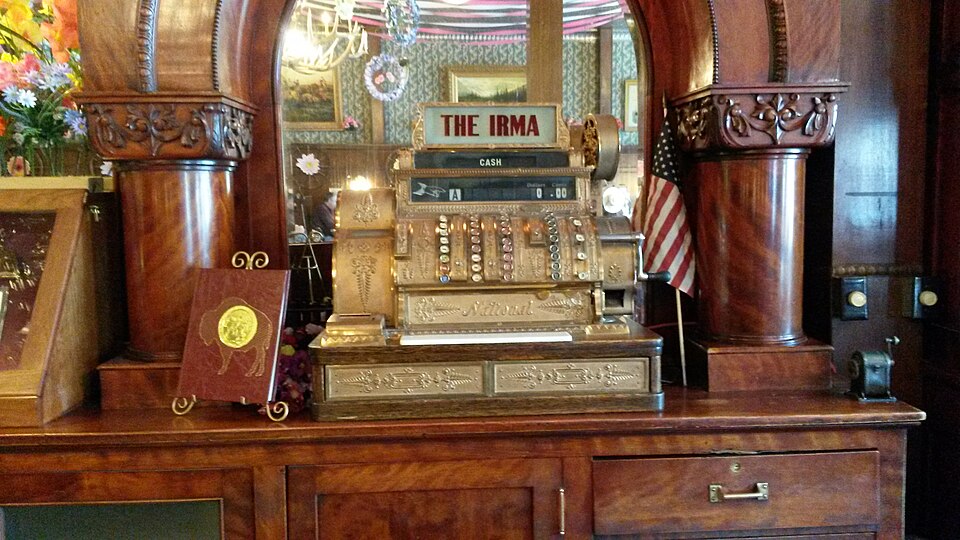 A typical hotel cash register with drawer compartments for different denominations and a receipt printer. (Image: Roger hallett, CC BY-SA 4.0, via Wikimedia Commons)
6. Role of Property Management Systems (PMS) in Accounting
PMS automates folio management, reduces errors, and provides real-time reporting. Key features include:
- Automated Charging: Room rates, taxes, and amenities are posted instantly.
- Payment Processing: Supports cash, card, and prepaid transactions.
- Reconciliation Tools: Compares PMS data with cash registers.
- Reporting: Generates daily, weekly, and monthly financial reports.
Comparison: Manual vs. PMS-Based Folio Management
| Feature | Manual Folio Management | PMS-Based Folio Management |
|---|---|---|
| Accuracy | High risk of human error | Minimal errors due to automation |
| Speed | Slow (manual entry) | Instant updates |
| Reconciliation | Time-consuming | Automated matching |
| Reporting | Manual compilation | Real-time dashboards |
| Scalability | Limited by staff capacity | Handles thousands of folios |
Example: PMS in a Luxury Hotel (e.g., The Pearl, Kathmandu)
- Scenario: 200 guests checked in on a weekend.
- PMS Benefits:
- Folios auto-generated with correct room rates and taxes.
- Payments processed via integrated payment gateways (e.g., Khalti).
- Daily reconciliation shows no discrepancies.
- Management dashboard tracks occupancy and revenue trends.
7. Guest Disputes and Complaints
Disputes arise from billing errors, unrecognized charges, or service issues. Handling them professionally is crucial for guest satisfaction.
Common Dispute Scenarios
| Dispute Type | Cause | Resolution Steps |
|---|---|---|
| Incorrect Charges | Wrong room rate or tax applied | Verify folio, adjust if needed |
| Unrecognized Charges | Guest unaware of amenities used | Explain charges, offer refund if justified |
| Payment Issues | Card declined or cash shortage | Offer alternative payment methods |
| Service Disputes | Poor service quality | Apologize, offer compensation |
Example: Handling a Guest Complaint
Guest: Ms. Gupta (Folio #F20230420) Complaint: Charged ₹3,000 for Wi-Fi when only ₹1,500 was used. Resolution:
- Investigate: Check folio shows ₹1,500 Wi-Fi charge + ₹1,500 unrecognized charge.
- Verify: Unrecognized charge was for a minibar item not billed separately.
- Apologize: Offer ₹1,500 refund or credit for next stay.
- Document: Update folio and guest feedback system.
8. Special Considerations for Folio Management
Corporate Folios
- Used for business travelers with company accounts.
- Charges are billed to the company, not the guest.
- Example: A salesperson from a multinational company staying at a hotel.
VIP Folios
- Personalized service and billing for high-net-worth individuals.
- Example: A celebrity staying at a 5-star hotel with a dedicated concierge.
IMAGE: Corporate hotel folio example
In the real world
Daraz’s Guest Tracking:
- Idea Used: Folio management for hotel partners.
- How: Daraz’s platform integrates with hotel PMS to track guest bookings, charges, and payments in real time. When a guest books a hotel stay through Daraz, their folio is automatically created with prepaid charges, and payments are processed via Daraz’s secure gateway. This reduces manual errors and ensures transparency for both the guest and the hotel.
- Worked Example: A guest books a 3-night stay at a hotel via Daraz for ₹15,000. Daraz pre-pays the hotel ₹15,000, and the hotel’s PMS auto-generates the folio with the room rate, taxes, and amenities. The guest pays Daraz, and Daraz settles with the hotel, eliminating the need for upfront cash handling.
Ncell’s Prepaid Billing:
- Idea Used: Prepaid folios for services.
- How: While not a hotel, Ncell’s prepaid billing system mirrors how prepaid folios work in hotels. Customers load credit into their Ncell accounts (like prepaid folios) and pay for services (calls, data) as they use them. If the balance runs out, they can top up. Similarly, hotels with prepaid folios ensure guests pay upfront for their stay, reducing the risk of non-payment.
- Worked Example: A guest books a room at a budget hotel and pays ₹10,000 upfront (prepaid folio). The hotel blocks the room and charges only the actual nights stayed (e.g., 2 nights at ₹5,000/night). The remaining ₹0 is credited back, much like how Ncell credits back unused prepaid balance.
Pathao’s Ride Tracking:
- Idea Used: Real-time folio reconciliation.
- How: Pathao’s app tracks ride bookings, payments, and balances in real time, similar to how a hotel’s PMS reconciles folios. When a guest books a ride, the fare is calculated instantly, and payment is processed via the app. Pathao’s system ensures no discrepancies between the app’s records and the driver’s earnings, much like how a hotel’s PMS reconciles cash register totals with folio records.
- Worked Example: A guest books a Pathao ride for ₹300. The app deducts ₹300 from their wallet balance and sends a notification to the driver. At the end of the day, Pathao’s system reconciles all rides booked, payments processed, and driver payouts to ensure accuracy, just as a hotel reconciles folios with cash transactions.
Exam Tip
This unit is highly practical and often tested with short-answer questions (SAQs) and long-answer questions (LAQs). Focus on the following for full marks:
Folio Types and Charges:
- Be able to list all types of folios (individual, group, master, prepaid, postpaid) and explain their use cases.
- Trace a folio with a worked example (like the one above) showing room rates, taxes, amenities, and payments.
- Mention common discrepancies in folios and how to resolve them (e.g., incorrect charges, unmatched payments).
Reconciliation and Cash Handling:
- Describe the step-by-step reconciliation process and why it’s important.
- Explain cash handling procedures (opening, daily transactions, closing) and the risks of poor handling (theft, errors).
- Compare manual vs. PMS-based reconciliation in a table (as shown above).
Guest Disputes:
- Provide real-world examples of disputes (e.g., incorrect charges, unrecognized amenities) and how to handle them.
- Mention the role of documentation and communication in resolving disputes.
Real-World Applications:
- Tie concepts to hotel scenarios (e.g., corporate folios, VIP folios) and Nepali examples (e.g., Daraz, Ncell, Pathao).
- Use Mermaid diagrams or tables to visualize processes like folio creation, reconciliation, or cash handling.
Past Exam Patterns:
- Expect SAQs like:
- "List the types of folios."
- "Explain the reconciliation process."
- "What are the common discrepancies in folios?"
- Expect LAQs like:
- "Trace the folio for a guest stay, including charges and payments."
- "Discuss the role of PMS in folio management with a comparison to manual systems."
- "How would you handle a guest dispute over unrecognized charges?"
- Expect SAQs like:
Pro Tip: Practice writing a full folio trace (like the worked example) with a hypothetical guest stay. This is a common LAQ and scores high if detailed and accurate. Also, memorize the cash handling steps and reconciliation process—these are often asked in short answers.
Based on the TU BHM syllabus for Front Office Operations II (BHM320), unit 8.
Discussion
Loading…