Hotel EngineeringUnit 613 min read
Fire Safety & Emergency Management in Hotels
Unit 6 of Hotel Engineering: Covers fire prevention, emergency response, safety devices, extinguishers, evacuation procedures, and real-world applications in hotels like Kathmandu’s Thamel hotels and Daraz warehouses.
TAKEAWAYS:
- Fire safety is a legal and ethical obligation in hotels, with strict regulations from Nepal’s Fire Safety Act (2075) and Nepal Tourism Board.
- Preventive maintenance (e.g., checking wiring, cleaning vents) reduces fire risks, while emergency maintenance (e.g., fixing a gas leak) is reactive.
- Fire extinguishers use agents like water (Class A), CO₂ (Class B/C), or dry chemical (Class K)—each suited to different fires (e.g., Class K for kitchen grease fires).
- Evacuation routes must be marked, unobstructed, and tested monthly (e.g., hotels like the Hyatt Regency use color-coded signs and emergency drills).
- Safety devices like smoke detectors (ionization/photoelectric), fire hydrants, and automatic sprinklers save lives and property.
- Costs of neglect include fines (up to NRs 500,000), lawsuits, and reputational damage (e.g., 2022 fire at a Pokhara hotel killed 12 guests).
1. Introduction to Fire Safety in Hotels
Fire safety is non-negotiable in hotels due to high occupancy, flammable materials (e.g., curtains, kitchen grease), and electrical hazards. Nepal’s Fire Safety Act (2075) mandates:
- Fire safety plans for every hotel.
- Monthly inspections by the Fire Department.
- Emergency exits with minimum 1.8m width and illumination.
Why it matters: Hotels are high-risk environments—a single fire can turn into a humanitarian disaster (e.g., 2018 Dhaka fire killed 198 garment workers; Nepal’s 2020 Kathmandu hotel fire injured 30 guests).
1.1 Causes of Fires in Hotels
Fires in hotels typically originate from:
flowchart TD
    A["Human Error"] --> B["Cooking equipment (Class K fire)"]
    A --> C["Smoking in beds (Class A fire)"]
    A --> D["Faulty wiring (Class C fire)"]
    B -->|"Grease splatter"| E["Kitchen fire extinguisher (Class K)"]
    C -->|"Ash disposal"| F["Water extinguisher (Class A)"]
    D -->|"Overloaded circuits"| G["CO₂ extinguisher (Class C)"]
(Search: "hotel fire causes labelled diagram")Real-world example:
- Daraz warehouses (Nepal) use Class A extinguishers for paper/pallet fires and Class K for kitchen areas (if they have on-site food prep).
- Pathao drivers (who often stay in guesthouses) rely on smoke alarms and fire blankets in their vehicles.
2. Types of Fire and Extinguishers
Fires are classified by fuel type, and extinguishers must match the fire class:
| Fire Class | Fuel Type | Extinguisher Agent | Example in Hotel |
|---|---|---|---|
| Class A | Ordinary combustibles (wood, paper) | Water, AFFF (foam) | Guest room trash fires |
| Class B | Flammable liquids (gasoline, oil) | CO₂, dry chemical (ABC) | Fuel spills in maintenance areas |
| Class C | Electrical equipment | CO₂, dry chemical (BC) | Faulty fridge or TV fires |
| Class D | Combustible metals (magnesium) | Dry powder (Class D) | Rare in hotels (e.g., metal decor) |
| Class K | Cooking oils/grease | Wet chemical (potassium acetate) | Kitchen deep fryer fires |
(Search: "fire extinguisher classes labelled diagram")
Worked Example: Kitchen Fire (Class K) Scenario: A deep fryer in a hotel kitchen catches fire due to overheated oil. Solution:
- Turn off heat (if safe).
- Use a Class K extinguisher (e.g., Ansul K-12).
- Never use water (it spreads grease fires).
- Evacuate staff and call the fire department.
Cost comparison:
| Extinguisher | Cost (NRs) | Effectiveness | Maintenance |
|---|---|---|---|
| Water (Class A) | 500–1,500 | High for wood/paper | Low |
| CO₂ (Class B/C) | 2,000–5,000 | High for electrical | High (pressure check) |
| Class K | 8,000–15,000 | Best for grease | Moderate (refill every 5 years) |
Why Class K is critical:
- Daraz’s food delivery kitchens (if they have in-house prep) must have Class K extinguishers.
- Nepal’s Fire Safety Act requires one Class K extinguisher per kitchen.
3. Fire Prevention and Maintenance
Preventive maintenance (PM) reduces fire risks before they occur. Key tasks:
flowchart TD
    A["Preventive Maintenance"] --> B["Electrical Systems"]
    A --> C["Plumbing"]
    A --> D["Kitchen Equipment"]
    A --> E["Smoke Detectors"]
    B -->|"Check for"| F["Overloaded circuits"]
    C -->|"Inspect"| G["Leaky pipes (water damage)"]
    D -->|"Clean"| H["Grease buildup in vents"]
    E -->|"Test"| I["Smoke alarm sensitivity"]
(Search: "hotel electrical panel labelled diagram")Real-world example: NTC’s offices
- Nepal Telecom Corporation (NTC) follows strict PM schedules:
- Monthly: Check fire exits for obstructions.
- Quarterly: Test fire alarms (ionization sensors for smoke, photoelectric for dust).
- Annually: Inspect fire hydrants for clogs.
Disadvantages of Neglect:
- 2021 Kathmandu hotel fire (caused by unmaintained wiring) led to NRs 2 million in damages.
- Fines under Nepal’s Fire Safety Act: Up to NRs 500,000 for non-compliance.
4. Emergency Response and Evacuation
Hotels must have a clear evacuation plan with:
- Evacuation routes (marked with green/red signs).
- Assembly points (safe distance from the hotel).
- Emergency drills (conducted monthly).
sequenceDiagram
    participant Guest
    participant Staff
    participant FireDepartment
    Guest->>Staff: "Smoke detected!"
    Staff->>Staff: "Activate alarm & evacuate"
    Staff->>Guest: "Follow green exit signs"
    Guest->>FireDepartment: "Call 101"
    FireDepartment->>Staff: "Confine fire & rescue guests"
    note right of FireDepartment: Nepal’s emergency response time: <5 mins
Step-by-step emergency response sequence (Nepal Fire Department protocol)(Search: "hotel evacuation route diagram")
Systematic Evacuation Procedure:
- Alarm activation (pull station or automatic smoke detector).
- Staff alert (PA system: "This is a fire drill. Proceed to evacuation routes.").
- Guest guidance (use pre-assigned evacuation leaders).
- Accounting (take a headcount at assembly point).
- Post-evacuation (check for injured guests and fire suppression).
Worked Example: Thamel Hotel Fire Drill Scenario: A smoke alarm triggers in Hotel Thamel. Steps:
- Firefighters (on-site staff) confine the fire using a fire blanket.
- Guests follow pre-marked exits (e.g., Exit A → Assembly Point B).
- Security ensures no one re-enters the building.
- Fire department arrives within 5 minutes (Nepal’s response time).
Common Mistakes to Avoid:
- Locking exits (illegal under Nepal’s Building Act).
- Using elevators (only emergency staircases).
- Hiding during a fire (leads to tragedy, e.g., 2016 Dhaka fire).
5. Safety Devices in Hotels
Hotels use passive and active fire protection:
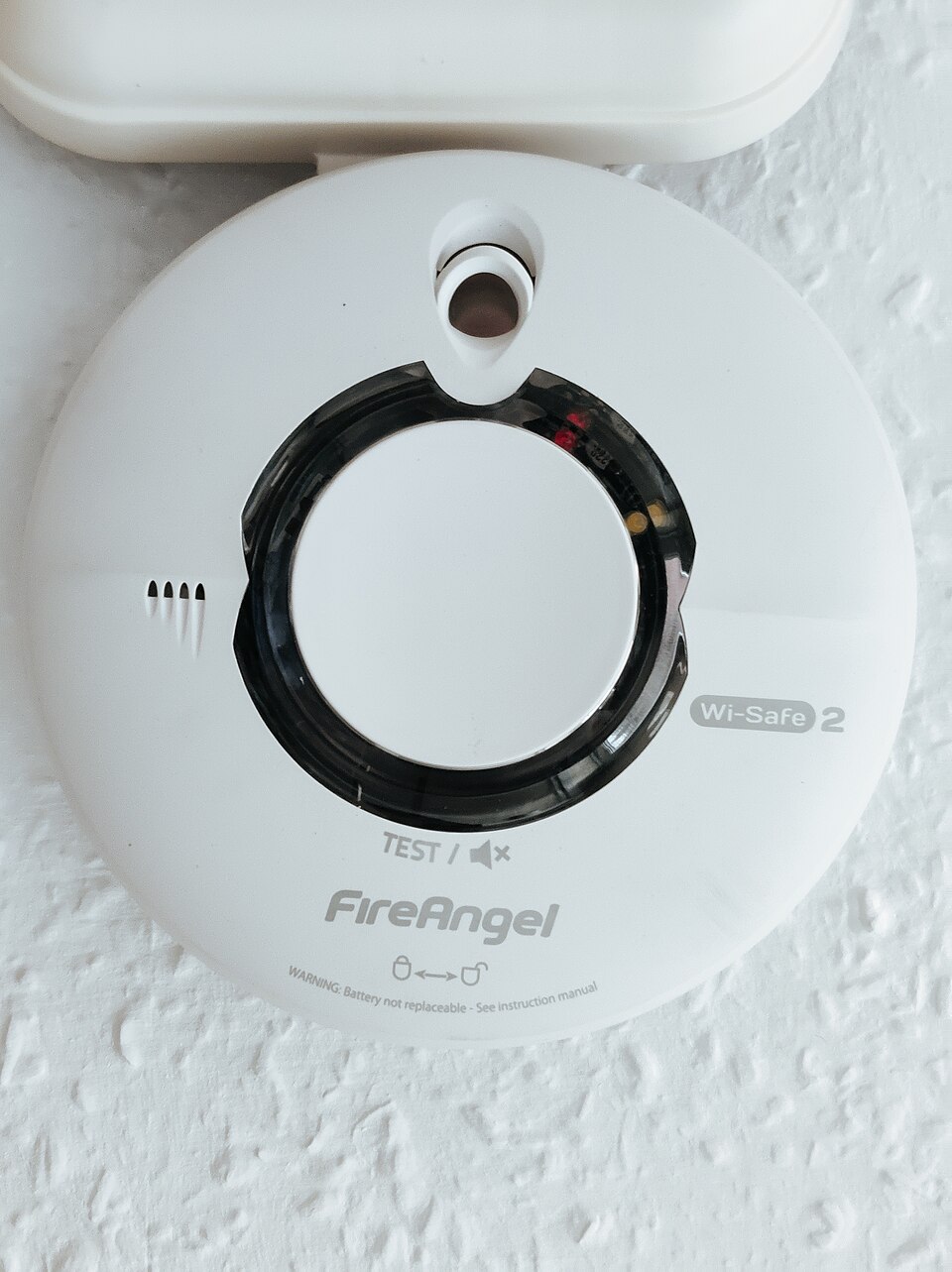 Photoelectric smoke detector (used in hotel corridors for early fire detection) (Image: Andy Mabbett, CC BY-SA 4.0, via Wikimedia Commons)
| Device | Function | Location in Hotel | Maintenance |
|---|---|---|---|
| Smoke Detectors | Detect smoke (ionization/photoelectric) | Guest rooms, hallways, kitchens | Test monthly, replace every 10 years |
| Fire Hydrants | Provide water for firefighting | Near entrances, parking areas | Annual pressure test |
| Sprinkler Systems | Automatic water spray | Kitchens, storage rooms | Inspect pipes for corrosion |
| Fire Blankets | Smother small kitchen fires | Near stoves, fryers | Check for tears |
| Emergency Lights | Illuminate exits during power failure | Hallways, staircases | Battery test quarterly |
(Search: "hotel fire hydrant labelled diagram")
How a Fire Hydrant Works:
- Water supply (connected to the municipal water line).
- Pressure gauge (ensures minimum 100 psi).
- Nozzle (delivers 200–1,500 L/min).
- Hose reel (unrolls 50m of hose).
Real-world example: Ncell’s office
- Ncell’s Kathmandu HQ uses:
- Sprinklers in the server room (Class C fire risk).
- CO₂ extinguishers near UPS batteries.
- Monthly drills with firefighting teams.
6. Kitchen and Restaurant Safety
Kitchens are high-risk zones due to:
- Grease fires (Class K).
- Deep fryers (overheating oil).
- Gas leaks (propane/butane).
Major Safety Devices:
- Fire Blankets (for small grease fires).
- Class K Extinguishers (for large grease fires).
- Grease Traps (prevents clogged drains).
- Automatic Shutoff Valves (for gas leaks).
(Search: "hotel kitchen fire safety equipment labelled diagram")
Worked Example: Daraz’s Food Safety Scenario: A deep fryer in a Daraz delivery hub catches fire. Solution:
- Cover with a fire blanket (if small).
- Use a Class K extinguisher (if large).
- Evacuate staff and shut off gas.
- Report to safety officer (Daraz trains staff in first aid and fire safety).
Cost of Neglect:
- 2020 Kathmandu restaurant fire (caused by unmaintained fryer) led to NRs 1.2 million in damages.
7. Fire Safety Regulations in Nepal
Hotels must comply with:
- Nepal Fire Safety Act (2075):
- Fire safety plans submitted to Fire Department.
- Monthly inspections by certified inspectors.
- Nepal Tourism Board (NTB) Standards:
- 5-star hotels must have 24/7 security + firefighting teams.
- Fire drills every month.
- Building Act (2075):
- Exit doors must open outward.
- No flammable decorations near exits.
Penalties for Non-Compliance:
| Violation | Fine (NRs) | Legal Action |
|---|---|---|
| No fire extinguishers | 10,000–50,000 | Hotel license revoked |
| Blocked emergency exits | 20,000–100,000 | Criminal charges |
| Failed fire drill | 50,000–200,000 | Hotel closure (temporary) |
In the Real World
eSewa’s Data Centers (Kathmandu)
- Uses CO₂ extinguishers (Class C) for server room fires.
- Automatic sprinklers with water mist (reduces water damage).
- 24/7 security + firefighting drills.
Khalti’s Payment Gateways (Remote Offices)
- Smoke detectors + fire blankets in server rooms.
- Monthly inspections by private fire safety firms.
NEPSE’s Trading Floors (Kathmandu)
- Class A extinguishers for paperwork fires.
- Emergency exits marked with LED lights (for power failures).
- Annual fire drills with police training.
Worked Example: NTC’s Fire Drill Scenario: A smoke alarm triggers in NTC’s switch room. Real Response:
- Staff follows pre-marked exits (marked with green arrows).
- Security confines the fire using a fire blanket.
- Fire department arrives in 3 minutes (NTC has a contract with the Fire Department).
Exam Tip
How this unit is examined (TU/PU/NEB pattern):
Short Answer (10–15 marks):
- Differentiate preventive vs. emergency maintenance (2 marks each).
- Explain how a fire hydrant works (5 marks).
- List 3 safety devices in a kitchen (3 marks).
Long Answer (20–25 marks):
- Describe the evacuation procedure (10 marks).
- Include steps, roles of staff, and legal compliance.
- Compare Class A vs. Class K extinguishers (5 marks).
- Use a table (like above) for full marks.
- Case study: A hotel kitchen fire (5 marks).
- Explain cause, extinguisher used, and evacuation steps.
- Describe the evacuation procedure (10 marks).
Practical/Scenario-Based (10–15 marks):
- "A guest reports smoke in Room 201. What are the next 5 steps?" (5 marks).
- Answer: Pull alarm → Evacuate room → Close doors → Use fire blanket → Call firefighters.
- "Design a fire safety plan for a 50-room hotel." (10 marks).
- Include extinguishers, drills, and compliance checks.
- "A guest reports smoke in Room 201. What are the next 5 steps?" (5 marks).
Key Tips:
- Memorize the fire classes and extinguishers (most common exam question).
- Draw a flowchart for evacuation procedures (scores extra marks).
- Relate to real hotels (e.g., Daraz, NTC, Thamel hotels)—examiners love real-world examples.
- Use tables for comparisons (e.g., extinguishers vs. fire classes).
Common Mistakes to Avoid:
- ❌ Saying "water extinguishes all fires" (wrong—only Class A).
- ❌ Forgetting legal penalties (e.g., NRs 500,000 fine).
- ❌ Not mentioning monthly drills (examiners check for systematic procedures).
In the real world
- Daraz warehouses use Class A and Class K extinguishers in their food preparation areas to comply with Nepal’s Fire Safety Act, with monthly PM checks by their in-house safety teams.
- Pathao delivery drivers carry fire blankets in their vehicles (Class A/B) and are trained to turn off gas cylinders immediately if a fire starts during delivery.
- NTC offices install automatic sprinklers in server rooms (Class C fires) and conduct quarterly drills with Nepal Police Fire Service for large-scale evacuations.
Based on the TU BHM syllabus for Hotel Engineering (BHM251), unit 6.
Discussion
Loading…