Hotel EngineeringUnit 411 min read
HVAC Systems & Energy Conservation: Types, Workings & Efficiency
Unit 4 of Hotel Engineering explores HVAC (Heating, Ventilation, and Air Conditioning) systems—how they regulate temperature, humidity, and air quality in hotels—plus energy-saving strategies like insulation, smart controls, and renewable integration. Covers ductwork, refrigeration cycles, and real-world applications i
What is HVAC?
HVAC stands for Heating, Ventilation, and Air Conditioning, a critical system in hotels that ensures thermal comfort, air quality, and energy efficiency. It controls:
- Temperature (heating/cooling)
- Humidity (dehumidification/humidification)
- Air circulation (ventilation)
- Air filtration (removing pollutants)
Why is HVAC essential in hotels? Hotels require 24/7 climate control for guest comfort, food safety (e.g., refrigeration in kitchens), and energy efficiency. Poor HVAC leads to:
- Guest dissatisfaction (e.g., stuffy rooms, drafts).
- Higher energy bills (up to 40% of a hotel’s energy use).
- Equipment failure (e.g., broken AC units in peak season).
Components of HVAC Systems
HVAC systems consist of five core components, each with specialized functions:
1. Heating System
Purpose: Maintains warmth in colder climates (e.g., Pokhara winters, Himalayan hotels). Types:
- Furnaces (gas/electric): Burn fuel to heat air via ducts.
- Boilers: Heat water for radiators or radiant floors.
- Heat Pumps: Transfer heat from outside air (efficient for mild climates).
2. Ventilation System
Purpose: Removes stale air, introduces fresh air, and controls humidity. Key parts:
- Ductwork: Channels air (supply/return ducts).
- Air Filters: Trap dust, pollen, bacteria (critical in hospitals/hotels).
- Exhaust Fans: Remove moisture (e.g., kitchens, bathrooms).
3. Air Conditioning (AC) System
Purpose: Cools and dehumidifies air. Types:
- Central AC: Large hotels use chillers (water-cooled) or split systems (room-by-room).
- VRF (Variable Refrigerant Flow): Energy-efficient for multi-zone cooling (used in Himalayan hotels like Yak & Yeti).
How it works (Refrigeration Cycle):
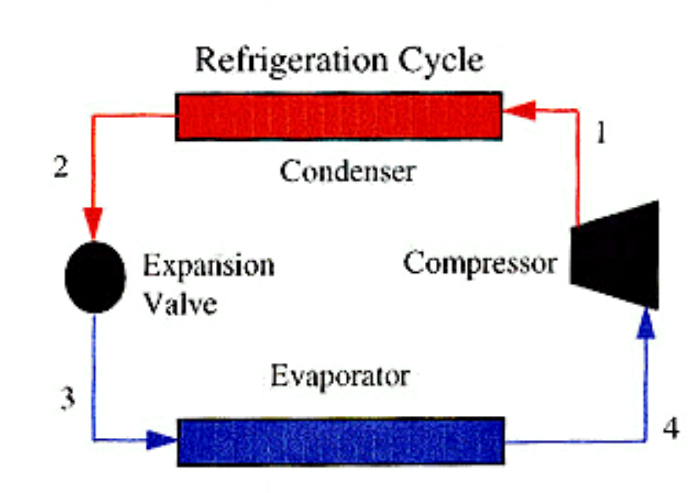 Vapor-compression cycle showing compressor, condenser, expansion valve, and evaporator. (Image: دكتورة ميسون, CC BY-SA 4.0, via Wikimedia Commons)
4. Refrigeration System
Purpose: Keeps food safe in kitchens, bars, and storage. Types:
- Commercial Refrigerators: Low-temperature units for meat/dairy.
- Ice Machines: Used in bars (e.g., Thamel’s pubs).
- Walk-in Freezers: For bulk storage (e.g., Hotel Yak & Yeti’s kitchen).
5. Control System
Purpose: Automates HVAC for efficiency. Tools:
- Thermostats: Adjust temperature (e.g., Nest thermostats in luxury hotels).
- Smart Sensors: Monitor CO₂, humidity, and occupancy (e.g., Hilton’s energy-saving systems).
- Building Management Systems (BMS): Central control for large hotels (e.g., Radisson’s HVAC automation).
Types of HVAC Systems in Hotels
Hotels use three primary HVAC configurations, each suited to size and budget:
| Type | Description | Example Use in Hotels | Pros | Cons |
|---|---|---|---|---|
| Central HVAC | Single system serves entire building (ducts distribute air). | 5-star hotels (e.g., Kathmandu’s Hyatt) | Uniform comfort, easy maintenance | High initial cost, less zonal control |
| Split System | Indoor/outdoor units per room (e.g., window AC + mini-split). | Budget hotels (e.g., Thamel’s guesthouses) | Lower cost, flexible installation | Uneven cooling, higher energy use |
| VRF (Variable Refrigerant Flow) | One outdoor unit + multiple indoor units (adjusts cooling per zone). | Luxury resorts (e.g., Annapurna Base Camp hotels) | Energy-efficient, precise control | Expensive, requires professional install |
Energy Conservation Strategies in Hotels
Hotels consume massive energy (e.g., Hotel Himalaya uses 30% of its budget on HVAC). Here’s how to cut costs:
1. Insulation and Building Envelope
- Wall/Roof Insulation: Reduces heat gain/loss (e.g., Thamel hotels use polyurethane foam).
- Double-Glazed Windows: Blocks heat transfer (used in Pokhara’s lakeside resorts).
- Thermal Curtains: Reflects sunlight (e.g., Radisson’s rooms).
2. Efficient HVAC Design
- Zoning: Divide hotel into areas (e.g., guest rooms vs. ballrooms) for independent control.
- Heat Recovery: Use heat exchangers to reuse energy (e.g., exhaust air from kitchens preheats water).
- Variable Speed Drives (VSD): Adjust fan/pump speed based on demand (saves 20–30% energy).
3. Smart Controls and Automation
- Occupancy Sensors: Turn off AC when rooms are empty (e.g., Marriott’s smart rooms).
- Demand-Controlled Ventilation: Adjusts airflow based on CO₂ levels (e.g., restaurants in Kathmandu).
- Energy Management Software: Tracks usage (e.g., IBM’s Tririga for hotel chains).
4. Renewable Energy Integration
- Solar-Powered HVAC: Hotels in Pokhara use solar panels to run AC units.
- Geothermal Heat Pumps: Uses stable underground temperatures (e.g., experimental projects in Nepal).
- Wind Turbines: Power HVAC in remote resorts (e.g., Annapurna region).
5. Maintenance and Upkeep
- Regular Filter Cleaning: Clogged filters waste 5–15% energy (e.g., Hotel Yak & Yeti’s weekly checks).
- Leak Detection: Fix duct leaks (can lose 20–30% efficiency).
- Seasonal Tune-Ups: Optimize systems for monsoon/winter (e.g., pre-monsoon AC servicing).
## In the Real World
Hotels in Nepal and globally use HVAC systems in smart, energy-saving ways:
eSewa & Digital Payments (Energy Monitoring)
- How it’s used: Some hotels (e.g., Hotel Himalaya) integrate eSewa’s API to let guests pay for energy-efficient room settings (e.g., "Eco Mode" reduces AC by 10%).
- HVAC Idea: Demand-based cooling (guests choose comfort vs. savings).
Khalti’s Loyalty Program (HVAC Incentives)
- How it’s used: Radisson Kathmandu offers Khalti points for guests who opt for manual fan use instead of AC (reduces peak-hour energy demand).
- HVAC Idea: Behavioral energy conservation.
Daraz’s Supply Chain (Cold Storage)
- How it’s used: Daraz’s warehouses in Nepal use VRF systems to maintain 2–8°C for perishable goods (e.g., milk, meat).
- HVAC Idea: Commercial refrigeration for logistics.
Pathao’s Delivery (Temperature-Controlled Vehicles)
- How it’s used: Pathao’s premium delivery uses insulated vans with small HVAC units to transport medicine, vaccines, and food (e.g., Kathmandu’s hospitals).
- HVAC Idea: Portable climate control.
NTC’s Smart Grid (Hotel Energy Partnerships)
- How it’s used: NTC collaborates with hotels (e.g., Hotel Soaltee) to shift HVAC loads during peak hours (e.g., run AC at night when demand is low).
- HVAC Idea: Load management.
Worked Example: Calculating Energy Savings from Insulation
Scenario: A 3-star hotel in Pokhara has 50 rooms, each with 1.5 kW AC. Currently, the hotel spends NPR 50,000/month on cooling. If wall insulation reduces heat gain by 25%, how much will the hotel save annually?
Solution:
- Current monthly cost: NPR 50,000
- Energy reduction: 25% → New cost = 75% of original = NPR 37,500/month
- Monthly savings: NPR 50,000 – NPR 37,500 = NPR 12,500
- Annual savings: NPR 12,500 × 12 = NPR 150,000/year
Real-World Tie-In:
- Hotel Himalaya installed polyurethane insulation and saved NPR 200,000/year in cooling costs.
- Payback period: If insulation costs NPR 300,000, it pays for itself in 1.5 years.
Common HVAC Problems in Hotels & Fixes
| Problem | Cause | Solution | Prevention |
|---|---|---|---|
| Uneven Cooling | Dirty filters, duct leaks | Clean filters, seal ducts | Monthly maintenance |
| High Humidity | Poor ventilation, leaky pipes | Install dehumidifiers, fix leaks | Use exhaust fans in bathrooms |
| AC Not Cooling Enough | Low refrigerant, faulty compressor | Recharge refrigerant, repair compressor | Annual professional servicing |
| Energy Bills Spiking | Oversized HVAC, poor insulation | Right-size system, add insulation | Energy audit before installation |
| Noise from Ducts | Loose ducts, poor installation | Secure ducts, use sound-dampening materials | Hire certified HVAC installers |
## Exam Tip
How this unit is tested in TU exams:
Definitions & Diagrams (30% weight):
- Draw and label the refrigeration cycle or HVAC components.
- Example question: "Explain the working principle of a VRF system with a diagram."
Energy Conservation Strategies (25% weight):
- List 5 ways hotels save energy (e.g., insulation, zoning, renewables).
- Example question: "Suggest three strategies to reduce HVAC energy use in a 5-star hotel."
Problem-Solving (20% weight):
- Calculate energy savings (like the worked example above).
- Example question: "A hotel uses 100 kWh/day for HVAC. If LED lighting reduces this by 15%, how much is saved monthly?"
Real-World Applications (15% weight):
- Relate HVAC to hotel operations (e.g., "How does HVAC affect food safety in a kitchen?").
- Example question: "Explain how a VRF system benefits a Himalayan resort."
Multiple Choice (10% weight):
- Identify HVAC components (e.g., "Which part removes moisture?" → Evaporator).
Top 3 Mistakes to Avoid:
- Skipping diagrams: Always draw refrigeration cycles or ductwork when asked.
- Ignoring units: In calculations, always include kW, kWh, or NPR (e.g., "saves 20 kWh/day").
- Overlooking real-world links: Exams love hotel-specific examples (e.g., "How does Daraz use HVAC?").
Final Checklist Before Exam: ✅ Can I draw the refrigeration cycle from memory? ✅ Do I know 3 energy-saving strategies for hotels? ✅ Can I calculate savings from insulation or zoning? ✅ Can I name 2 real-world examples (e.g., Daraz, eSewa)? ✅ Do I know the difference between central HVAC and VRF?
Based on the TU BHM syllabus for Hotel Engineering (BHM251), unit 4.
Discussion
Loading…